
A Guide to Hydrolyzed Sponge in Skincare
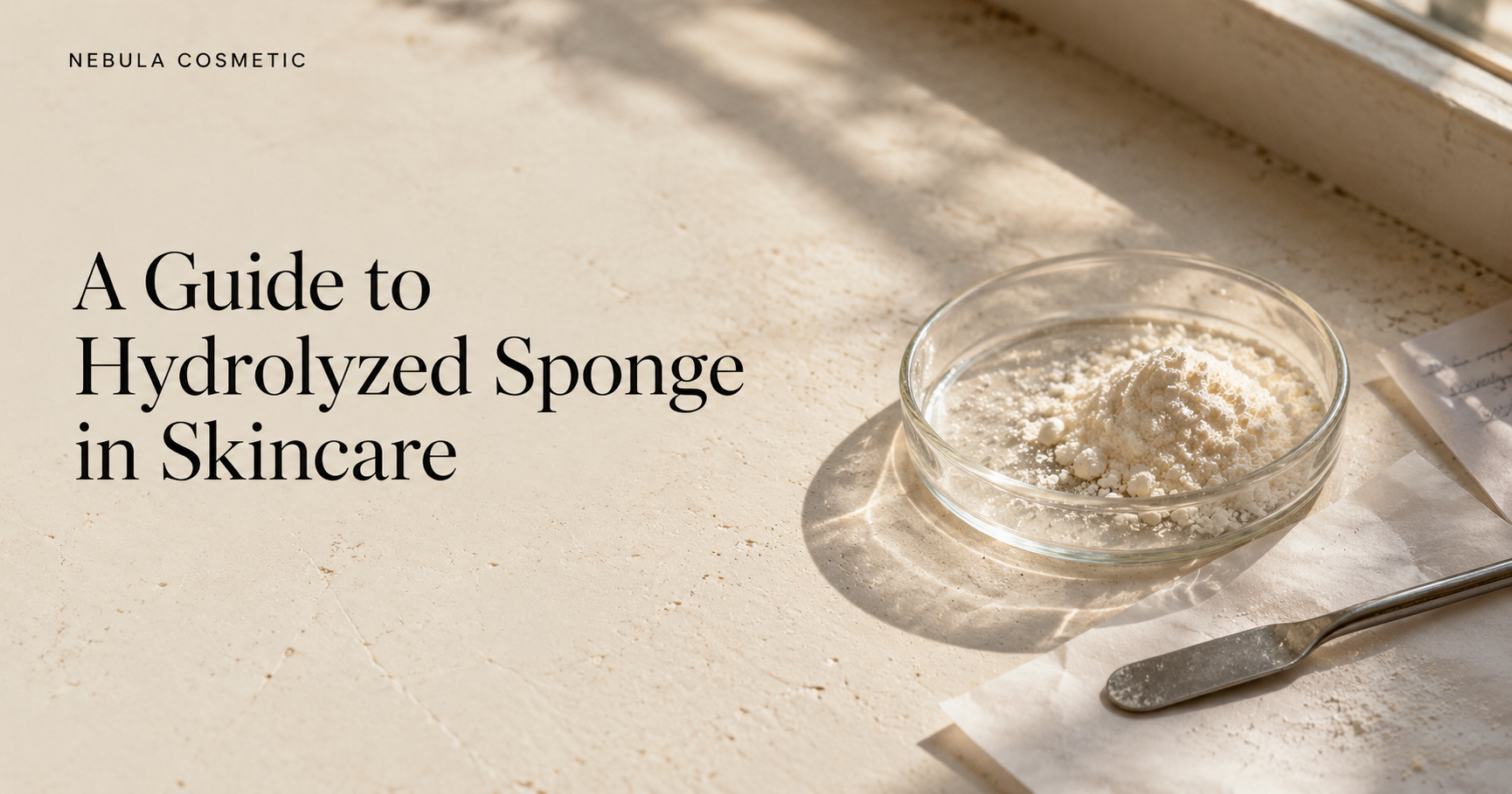
Hydrolyzed Sponge is a sponge-derived cosmetic ingredient associated with the tiny, needle-shaped structures called spicules. It appears in professional resurfacing products and consumer skincare, often under names such as sponge microneedles or spicule skincare.
For a brand choosing a formula, however, the ingredient name is only a starting point. The material specification, finished formula and application method all affect the product a customer actually uses.
At Nebula Cosmetic, our perspective is that of a finished-product manufacturer. A useful discussion begins with what the brand wants to make: a professional gel, a powder mixed before application, or a product intended for home use.
This guide explains the ingredient in plain language and the questions worth asking before developing a range.
1. What Hydrolyzed Sponge Actually Means
Sponges are aquatic animals. Certain species contain a supporting framework of microscopic structures called spicules. The siliceous spicules used in this category are largely composed of silica, a mineral material. They are different from the soft, absorbent household sponge that the name may bring to mind.
What The Ingredient Name Tells You
Hydrolyzed Sponge is an ingredient name used for processed sponge material. Commercial cosmetic grades may be supplied as powders containing refined spicules. A supplier can also offer the material within a blend or dispersion, so it is important to read the full composition rather than rely on the trade name. One raw-material manufacturer, for example, lists freshwater-derived grades with different spicule contents and dimensions. That illustrates why the same ingredient name can cover different specifications.
Freshwater and marine sources both appear in the wider spicule field. A brand should confirm the source of the material it is buying rather than describe every sponge ingredient as marine-derived. The name alone also says little about the purification process, particle dimensions or suitability for a particular formula.
Notice:Use Hydrolyzed Sponge as the starting point for a supplier enquiry. Ask for the source, full composition and specification before comparing materials.
Sponge Origin and Product Claims
Because sponges are animals, sponge-derived spicules should not be presented as plant-derived. A vegan claim would need careful scrutiny of the actual material. Likewise, the term “algae peel” may describe a product concept, but algae and sponge are different organisms. An algae ingredient in a formula does not establish the source of its spicules.
2. Understanding The Names Used on Product Pages
Ingredient Names and Treatment Names
Hydrolyzed Sponge, sponge spicules and sponge microneedling are related terms, but they serve different purposes. Hydrolyzed Sponge identifies a cosmetic ingredient. Sponge spicules describes the physical structures. Sponge microneedling usually describes a topical product or treatment concept involving those structures.
Why Liquid Microneedling Needs Explanation
“Liquid microneedling” is a marketing expression. It does not establish that a liquid product works like a microneedling device. Traditional microneedling uses a device with needles and defined operating parameters; a topical spicule formula has a different design and application process. Evidence for one should not be used to promise the same results from the other.
For a brand website, the clearest approach is to explain the terminology once, then describe the actual product consistently. A professional spicule gel is a more useful description than several interchangeable claims about invisible needles, biological needles and liquid treatments. Customers should be able to tell what is in the package and how it is intended to be used.
3. How Sponge Spicules Interact With Skin
What Delivery Research Shows
Spicules have a physical structure that can interact with the skin barrier during application. Research has explored their ability to create small pathways and change the passage of selected substances through skin. A 2017 study examined marine sponge spicules and delivery of model molecules in experimental skin systems. It found that delivery depended on factors including dose and molecular size.
For skincare development, this suggests a potential delivery approach worth investigating. It does not prove that every spicule serum delivers every active ingredient effectively. The experimental material, test substance, formula and application conditions matter. Later research combining spicules with liposomes also illustrates how a delivery system can involve several interacting components. [3]
What Tingling Can and Cannot Tell You
A customer may notice prickling during or after application. That sensation does not measure absorption, collagen production or product quality. A formula that feels stronger is not automatically more effective, and discomfort should not become a target in product development.
There is also no single residence time, penetration depth or recovery period that applies to all products containing Hydrolyzed Sponge. Avoid borrowing a precise number from a study or another brand unless the evidence actually supports the material and finished product being described.
Important: Judge a sample against its intended cosmetic purpose and use conditions. A stronger prickling sensation does not establish better results.
4. What Benefits A Skincare Brand Can Reasonably Explore
Hydrolyzed Sponge can be considered when developing products positioned around surface texture, dullness or a professional resurfacing experience. The wider formula may add hydration, conditioning or other cosmetic benefits. Each proposed benefit still needs to be assessed at the finished-product level.
A useful development brief names a visible concern. “Improve the appearance of rough texture” gives a clearer direction than “rejuvenate every skin layer.” For a brightening concept, the team should decide whether the desired result is improved radiance or a more even-looking tone, then choose ingredients and evaluation methods accordingly.
Claims about acne treatment, scar removal, deep tissue regeneration or guaranteed collagen stimulation require a different level of scrutiny. They should not be inferred from the ingredient name or from delivery research. Adding a peptide, for instance, does not by itself demonstrate a firming result in the final formula.
Manufacturers and brands should agree early on what evidence will support the proposed wording. Depending on the claim, that may involve instrumental measurements, a structured use study or another suitable evaluation. Photographs can help communicate a result when lighting, timing and image handling are controlled; casual before-and-after pictures are a weak basis for a broad promise.
Formulation strategy: The most effective anti-aging moisturizers incorporate all categories rather than relying solely on one approach, creating comprehensive hydration that addresses both immediate and underlying moisture deficits.
5. Why The Raw Material Specification Matters
Two powders carrying the same ingredient name may behave differently in a product. Purchasing therefore needs more detail than a photograph of white powder or a statement that the material is highly purified.
Spicule Size and Shape
Spicule dimensions and shape deserve attention. Ask for the measurement method, the range observed and representative images where available. A single average can hide variation. The condition of the material after processing and handling may also matter, so a useful specification should explain what is being assessed.
Purity and Spicule Counts
Purity claims need a definition. A percentage might refer to spicule content, silica content or another measured parameter. Those figures are not interchangeable. The supplier should identify the test method and provide batch documentation that matches the claim.
The same applies to spicule counts. A count per gram of raw material cannot be compared directly with a count per bottle of finished product. A meaningful comparison requires the same units, the amount used and a credible counting method. A large number on a label is not a complete performance specification.
Notice: When comparing supplier figures, check what was measured and the units used. Purity, spicule count and finished-product loading describe different things.
Supplier Documents and Quality Controls
For a natural material, microbiological quality and relevant impurity controls also belong in supplier assessment. Request the specification, certificate of analysis and supporting safety information. A safety data sheet helps with material handling, but it does not replace an assessment of the finished cosmetic under its intended conditions of use.
6. Choosing A Product Format
A gel and a powder-and-activator kit can both use sponge-derived material, yet they create different development tasks. The choice should follow the customer’s channel and method of use.
Gels and Particle Distribution
In a gel, the manufacturer needs to assess how evenly the spicules remain distributed, how the product flows and whether the package dispenses it consistently. A gel that looks uniform immediately after mixing may still change during storage. The sample should be checked over time in the intended packaging.
Powder and Activator Kits
A powder-and-activator kit introduces a mixing step. That makes the powder dose, liquid volume, mixing instructions and time between preparation and use important. Separate containers can support a freshly mixed concept, but separation alone does not establish superior efficacy, sterility or stability. Both components and the prepared mixture need appropriate evaluation.
Products Intended for Home Use
A product intended for home use needs instructions that work without a practitioner present. Package design, dispensing and frequency guidance become especially important. A professional formula should not simply be relabeled for retail because the ingredient is also found in consumer skincare.
For a first launch, choosing one clearly defined format often makes the brief easier to manage. Additional products can follow when they offer a practical difference that customers understand.
Development Tip Evaluate the complete kit as the customer will use it, including measuring, mixing and dispensing. Record any step that needs clearer instructions.
7. Building the Formula Around the Spicules
Hydrolyzed Sponge does not replace the work of designing the base formula. Texture, preservation, compatibility and the other ingredients still determine whether a sample is suitable for further development.
Texture and Application Requirements
The base needs to carry the particles consistently and suit the intended application. A professional gel may need a particular spreading time or removal method. A leave-on product needs a different sensory assessment. These requirements should be written into the brief before a texture is approved.
Selecting Companion Ingredients
Humectants and skin-conditioning ingredients can support the overall formula, but adding soothing ingredients does not guarantee that a spicule product will suit reactive skin. The full formula and method of use need to be considered together. Individual ingredient reputations are not a substitute for that work.
Combining spicules with exfoliating acids, retinoids or other demanding actives adds further questions about compatibility and tolerance. Whether a combination is appropriate depends on its composition and intended use. A long active-ingredient list gives a brand more names to discuss, but it can make the product harder to evaluate and explain.
Manufacturing and Filling
Processing also deserves attention. The team should check whether mixing, transfer and filling affect particle distribution or integrity. Batch size changes may alter those conditions. A successful laboratory sample therefore needs to be followed by suitable production trials and quality checks.
8. Concentration and Treatment Strength
There is no universal percentage that makes Hydrolyzed Sponge suitable for every professional or retail product. A concentration figure needs context: what raw material is being added, how much of that material consists of spicules and how much finished product is applied.
For example, adding the same percentage of two differently composed raw materials does not necessarily give the same spicule loading. Blends containing carriers add another layer to that comparison. The supplier’s composition information should be available before a brand compares percentages between samples.
Application pressure, duration and frequency also affect exposure. That is why strength labels such as mild, medium and professional should be tied to a defined product and instructions. They are not standardized grades across the industry.
A sensible sample review records the application conditions alongside the feedback. “More tingling” is not a useful acceptance criterion on its own. The team needs to judge whether the product meets its intended cosmetic purpose with an acceptable use experience.
9. Safety Guidance Belongs in Product Development
A naturally sourced ingredient can still produce an unwanted skin response. A spicule product should be assessed for the intended user, application area and method of use before instructions are finalized.
Suitability and Skin Tolerance
Products should provide clear guidance on unsuitable skin conditions and areas to avoid. Broken, infected or severely irritated skin deserves particular caution. Sensitive-skin or post-procedure positioning needs specific support; it should not be assumed because the formula includes panthenol, ceramides or botanical extracts.
A local tolerance check, when recommended in the product instructions, does not guarantee suitability for a full application. Severe burning, swelling or persistent irritation should not be described as proof that a treatment is working. Professional guidance should explain how to respond to an adverse reaction.
Product Specific Aftercare
Aftercare instructions should match the actual product and evaluation. Brands should avoid copying a competitor’s fixed schedule for cleansing, active ingredients or repeat treatments. The same care applies to claims such as no downtime, daily use and suitable for all skin types. Each describes a use condition that needs evidence.
10. Turning An Ingredient Idea Into A Useful Product Brief
Before requesting samples, decide who will use the product and what they need from it. An importer supplying salons may prioritize clear professional instructions and consistent replenishment. A retail brand may place greater emphasis on controlled dispensing and simple home-use guidance.
Information to Include in Your Brief
A practical brief should identify the target market, sales channel, product format, cosmetic concern and preferred packaging. It should also state which claims are essential and which are optional. This gives the manufacturer a basis for discussing feasibility rather than building a sample around an open-ended promise of stronger results.
Project Tip: State the intended user and application setting before asking for a stronger formula. Those details give the manufacturer a clearer basis for selecting the format and planning evaluation.
Evaluating Samples Before Production
During sample assessment, keep application conditions consistent and record feedback systematically. Ask what has been tested, what remains to be tested and whether the sample uses the material intended for production. Review the package with the formula, since a dispensing problem can undermine an otherwise acceptable product.
At Nebula Cosmetic, our sponge microneedle collection provides a starting point for these discussions. Brands and professional skincare distributors can review the product range, shortlist relevant formats and discuss samples and customization. The most useful enquiry describes the intended customer and use setting, so the conversation can focus on a product that fits the business.
You May Also Like
Develop Your Skincare Products
Looking to launch your own skincare line? Our experienced team can support you through every stage of the development process. From custom formulation and ingredient selection to packaging and full-scale manufacturing, we provide complete OEM and private label solutions tailored to your brand.
