
Professional Spicule Treatments vs At-Home Skincare
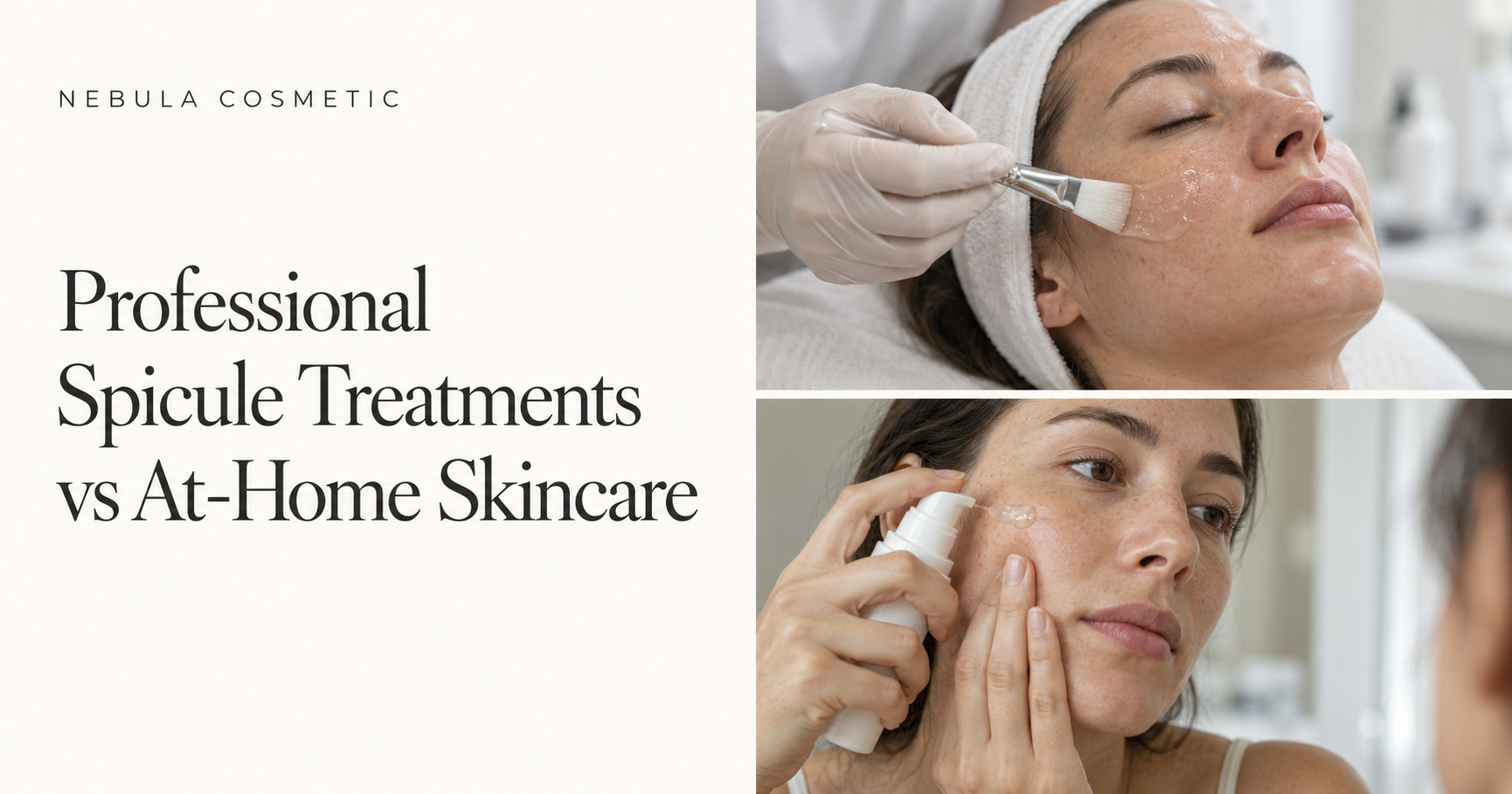
Professional spicule treatments and at-home spicule skincare may use related ingredients, but they need different product designs. A professional treatment is applied within a defined service, with someone responsible for assessing suitability, following the instructions and explaining aftercare. A home-use product needs to support appropriate use when that practitioner is absent.
For a brand, the difference affects the formula brief, packaging, instructions and customer support. Choosing a professional channel does not simply mean increasing the spicule concentration. Choosing retail does not simply mean reducing it. At Nebula Cosmetic, we start with who will apply the product, under what conditions and with what guidance.
This guide compares professional topical spicule treatments with skincare designed for home use. It also distinguishes home-use spicule products from ordinary moisturizers and other aftercare products, which may contain no spicules at all. That distinction matters when building a range for clinics, salons or distributors.
1. What Professional And Home Use Actually Mean
A Professional Product Belongs To A Defined Service
A professional spicule product may be supplied as a gel or a powder-and-liquid system. Its directions should define the preparation and application conditions supported by its evaluation. The practitioner needs to know how to assess suitability, apply the product and respond when a client reports a problem.
The service includes more than the product itself. Consultation, record keeping and follow-up help an institution manage how the treatment is delivered. Their value depends on how well they are carried out; a professional label alone does not demonstrate a better result.
Home Skincare Covers Different Kinds Of Products
At-home spicule skincare is formulated and presented for customers to apply themselves. It may be sold through a clinic, an online shop or another retail channel. A product purchased from a professional institution can still be a home-use product if that is its intended application setting.
Homecare also includes conventional products such as cleansers, moisturizers and sunscreen. These should not be confused with a second spicule treatment. A range can include a professional spicule product and supporting homecare without requiring spicules in every step.
Manufacturer’s Note: Separate three roles in the product brief: professional treatment, home-use spicule skincare and supporting homecare. Each needs its own purpose and instructions.
2. The Main Differences At A Glance
These distinctions describe development priorities. They do not establish that every professional formula is stronger or that every retail product is suitable for frequent use.
Consideration | Professional spicule treatment | Home-use spicule skincare |
Application setting | A defined service with practitioner guidance | Independent use according to retail directions |
Formula brief | Supports the specified professional procedure | Supports the intended home routine |
Dose and method | Defined in the treatment instructions | Clear enough for customers to follow themselves |
Schedule | Specific to the treatment and its evaluation | Specific to the retail formula and its evaluation |
Packaging priority | Preparation, portioning and professional handling | Dispensing, repeated use and clear instructions |
Support | Staff information and client follow-up | Accessible directions and customer service |
Product role | An appointment-based service product | A defined step within a home routine |
3. Why Concentration Alone Does Not Define The Channel
The Complete Exposure Matters
Spicule material can vary in composition, particle characteristics and the way it is incorporated into a formula. The amount applied and the application technique also influence the use experience. A raw-material percentage gives only one part of that information.
For a meaningful discussion, a manufacturer needs to know the intended dose, application area and method. A formula reviewed under professional handling conditions has not automatically been evaluated for customers using different amounts or repeating it at home.
A thicker gel can change spreading and handling without necessarily changing the spicule content. Likewise, changing the mixing liquid in a powder system can alter the prepared product. The whole formula and its directions need to be considered together.
Brand Strength Levels Are Not A Universal Scale
Numbers, colors and names can help customers navigate one brand’s range, but they should not be treated as standardized measures across suppliers. A level called professional or intensive does not establish a particular particle size, concentration or treatment outcome.
VT Cosmetics provides a useful example of product-specific retail instructions: its official pages describe different schedules for Reedle Shot 100 and Reedle Shot 700. Those are directions within that range, rather than a general schedule for other spicule products.
A new private label product therefore needs its own supported instructions. Copying another brand’s frequency because the product has a similar name or sensation is not a sound development method.
Buyer’s Note: Ask what a strength label represents in the actual formula. Compare the material, application dose and method before comparing numbers on packaging.
4. Formulating For A Professional Setting
Define The Procedure Before Approving The Texture
A professional brief should describe how the product fits into the appointment. Does it arrive ready to apply, or does the practitioner prepare it? Is it removed or left on according to the supported instructions? What products are intended to follow it?
Those answers guide texture, spreading time and packaging. A formula that performs well in a sample jar may still be awkward in the proposed professional pack. The team should review the presentation using the handling method planned for the service.
Professional products also need clear boundaries. A practitioner should not have to invent the mixing ratio, extend the working time or substitute another liquid because the technical sheet is incomplete. Changes to the procedure should be evaluated rather than treated as routine customization.
Support Consistent Delivery Across Staff
For institutions with several practitioners, the manufacturer can help by providing clear product information and directions. The institution then needs a practical way to train staff and record what was used. This makes feedback easier to interpret and helps identify inconsistent handling.
A single-use presentation may simplify portioning, while a multi-use pack may suit another service model. Neither format guarantees consistency. Dispensing, transfer losses and preparation all deserve review in the proposed pack.
A professional range should make its differences easy to explain. If two treatments have similar positioning, the supplier needs to clarify their practical distinction rather than relying on color or a stronger sensation.
5. Designing Skincare For Use At Home
Instructions Must Work Without A Practitioner Present
Home-use directions need to answer ordinary questions clearly: how much to apply, where to avoid application, how often to use it and which combinations are unsupported. The instructions should also explain what to do if a customer develops a reaction.
Packaging can reduce uncertainty. A dispenser may help customers portion the product, provided it works reliably with the formula. A cap, label or leaflet should make the intended use clear without requiring the customer to find a video first.
Additional online guidance can support the pack, but essential information needs to remain accessible. Product pages, leaflets and customer-service replies should all describe the same use conditions.
Consider Foreseeable Changes To The Routine
At home, a customer may already use exfoliating acids, retinoids, scrubs or another spicule product. They may assume that adding more steps will improve results. The product brief should consider those foreseeable situations when developing combination guidance.
A formula with moisturizing ingredients is not automatically suitable for sensitive or recently treated skin. Nor does a professional endorsement establish that a retail product suits every customer. Suitability claims need support for the product and its intended use.
Development Tip: Have a representative user explain the directions back in their own words. Confusion about dose, frequency or layering is a reason to improve the instructions before launch.
5. Frequency And Aftercare Need Separate Decisions
A Professional Appointment Is Not A Retail Schedule
An appointment-based product and a home-use formula should each have a schedule supported by their own evaluation. A professional service is not necessarily repeated more often, and a retail product is not necessarily intended for daily use.
Frequency should not be increased just because a customer experiences less prickling or sees no obvious peeling. Sensation and visible shedding do not provide a reliable measure of whether another application is appropriate.
When developing a range, avoid a marketing ladder that assumes every customer should progress to the highest level. A clear role for one suitable product is more useful than encouraging escalation without an individual reason.
Immediate Aftercare And Later Maintenance Are Different Roles
A product intended for later maintenance is not automatically appropriate immediately after a professional treatment. The timing needs to follow the treatment instructions and the customer’s condition. There is no single restart interval for all spicule products and all procedures.
Professional brands can organize treatment and follow-up as a system. For example, SQT Beauty USA describes selected finishing products and personalized post-care instructions within its professional service. That illustrates a service structure; it does not validate the same products or sequence for another manufacturer’s formula.
A manufacturer should identify which supporting products have been considered with the treatment, at what stage and under which conditions. A generic statement that a serum is soothing is not enough to establish its place immediately after a procedure.
Important: Home-use spicule skincare and immediate aftercare are different categories. Do not recommend one as the other unless that exact use is supported.
6. What Professional Guidance Can Add
Clear Instructions Can Influence Product Use
Professional support can help customers understand the amount, method and routine intended for a product. An eight-week study published in 2026 examined a microneedle cream in 21 women and compared when participants received structured skincare instruction. It reported differences in selected skin measurements between the groups.
The study involved a particular cream and instruction program. It did not compare a salon spicule treatment with a home serum or prove that professional products are inherently more effective. For a manufacturer, its useful lesson is to include the quality of instructions in product development rather than treating education as an optional marketing extra.
Support Needs To Continue After The Sale
A homecare customer should know how to contact the brand or institution with a question. Staff need a consistent response process, especially when the customer asks about combining products or restarting use after a professional service.
Record the product name, batch information and reported use conditions when investigating feedback. A useful customer-service record distinguishes a packaging problem, an unclear instruction and a possible adverse reaction. Each may need a different response.
7. Packaging And Quality Checks Follow The Use Setting
Professional Packs Must Fit The Service
Professional packaging should support the intended preparation and application. For a kit, that includes matching components and clear identification. For a multi-use gel, it includes a practical dispensing method that avoids repeated contact with used tools.
The supplier should explain how the formula and pack have been assessed together. Staff need directions for handling opened containers and prepared mixtures. A sealed vial does not establish sterility, and a single-use presentation should not be repurposed without appropriate support.
Retail Packs Must Remain Usable Over Repeated Applications
A retail product may be opened and stored by customers in different environments. Its assessment should reflect the intended pack, shelf life and conditions of use. Ease of closing, dispensing and reading the label can be as relevant as the appearance of the bottle.
The FDA identifies packaging, preservation, storage and consumer handling among potential sources of cosmetic contamination. Those considerations apply to both channels, although their practical handling patterns differ.
A brand should therefore ask about finished-product quality controls and packaging compatibility. Factory credentials are useful background, but the proposed product still needs its own assessment.
8. Building A Range For Institutions And Distributors
Give Each Product A Distinct Commercial Role
A professional treatment can be the service product, with supporting homecare available for appropriate follow-up. An additional home-use spicule product may serve a separate maintenance role if the formula, timing and directions support it. The range does not need to include all three roles at launch.
For a distributor, a focused range can make training, inventory and customer support easier to organize. Start with the product customers can explain and use consistently, then add another format when there is a clear gap in the service or retail offering.
A professional and retail version should have a meaningful distinction in the brief. That may involve the use setting, formula, package or instructions. Simply offering the same product in a larger and smaller bottle does not by itself establish two different purposes.
Compare The Full Cost Of Each Channel
Professional supply involves more than the formula cost. Consider treatment portions, preparation materials, technical documents and staff support. Retail supply also involves consumer packaging, clear instructions and a process for handling questions and returns.
When requesting a quote, specify what is included. A professional kit with training materials cannot be compared fairly with a retail bottle on unit price alone. Likewise, a larger professional pack is useful only if the institution can use it within the supported conditions after opening.
Procurement Tip: Ask for the formula, packaging, documentation and support to be itemized. This makes it easier to compare suppliers against the channel you actually plan to serve.
9. A Practical Brief For Private Label Development
Information To Give The Manufacturer
Describe the target customer, market and cosmetic concern first. State whether the product will be applied by a practitioner, used independently at home or supplied as supporting homecare. Include the preferred format and whether an institution will recommend or supervise the retail routine.
Also explain the claim you want to make and the evidence you expect to need. “Professional-inspired” is a marketing description, not an evaluation plan. A manufacturer needs concrete use conditions before it can discuss a suitable formula and development work.
Questions To Resolve Before Approval
Ask which material and finished formula are proposed, what has been evaluated and which checks remain. Review the actual package and instructions with the sample. If a professional product and a home product are being developed together, confirm their separate roles and the supported transition between them.
Keep the acceptance criteria clear. Sample feedback should cover usability and the intended product experience, while safety, stability and claims need appropriate assessment. A stronger sensation or a more elaborate kit should not be the deciding factor by itself.
At Nebula Cosmetic, our professional sponge microneedle collection provides a starting point for discussing product formats and customization. Share your channel and intended use so we can focus the discussion on a defined product role. A range becomes easier to sell and support when each formula has a clear purpose, suitable packaging and instructions that its actual user can follow.
You May Also Like
Develop Your Skincare Products
Looking to launch your own skincare line? Our experienced team can support you through every stage of the development process. From custom formulation and ingredient selection to packaging and full-scale manufacturing, we provide complete OEM and private label solutions tailored to your brand.
