
Sponge Microneedling vs Traditional Microneedling: Key Differences
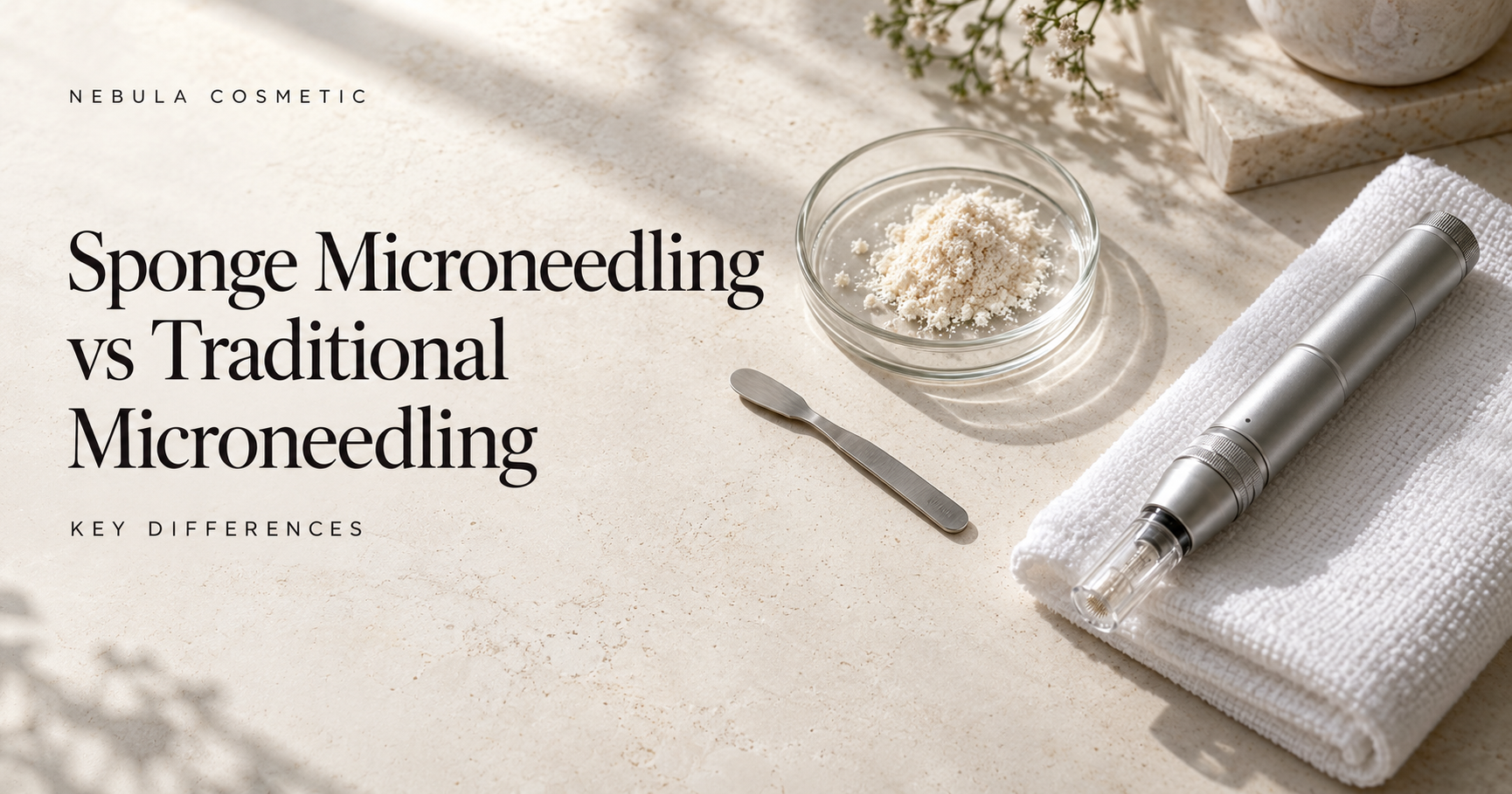
Sponge microneedling and traditional microneedling both involve microscopic needle-like structures, but they are different technologies. One uses sponge-derived spicules within a topical product or treatment system. The other uses a device to repeatedly insert and withdraw needles. Their application methods, development requirements and supporting evidence need to be evaluated separately.
For a skincare brand or professional distributor, that distinction affects the product brief, practitioner guidance and claims on the label. At Nebula Cosmetic, we approach this comparison as a cosmetic manufacturer: what can a spicule formula offer, what must be tested, and where should it remain clearly separate from a device procedure?
This article compares topical sponge spicule products with conventional mechanical microneedling using pens, rollers or stamps. Radiofrequency microneedling adds energy delivery and is outside this comparison. The discussion is intended to support product selection and development, rather than provide an operating protocol.
1. Understanding the Two Approaches
Sponge Spicules in Topical Skincare
Sponge microneedling generally describes the topical use of microscopic sponge-derived spicules. In cosmetic ingredient lists, processed sponge material may appear as Hydrolyzed Sponge. Depending on the product, spicules can be incorporated into a gel or another base, or supplied in a powder mixed with a liquid before application.
Their physical interaction with the skin depends on the material specification, formulation, amount applied and application method. A product name does not tell a buyer the spicule dimensions or the finished-product loading. Those details belong in the technical discussion with the manufacturer.
Needles Attached to A Device
Conventional microneedling uses needles attached to a pen cartridge, roller or stamp. Needles enter and leave the skin as the device moves. Some motorized devices allow a practitioner to adjust needle projection and speed. Device instructions define the intended procedure and operating conditions.
These are different ways of applying a physical structure to skin. Calling a serum “liquid microneedling” does not demonstrate that it produces the same tissue response or clinical outcome as a particular device.
Notice: Compare a defined formula with a defined device procedure. Broad labels such as natural microneedling and traditional microneedling hide differences that matter to product selection.
2. The Differences At a Glance
The table below outlines development and use considerations. It does not rank either approach or establish that one is suitable for a particular client.
Comparison | Topical sponge spicule products | Conventional mechanical microneedling |
Physical format | Spicules in a base formula or prepared mixture | Needles attached to a pen, roller or stamp |
Application control | Material, formula, dose and technique | Device design, settings and operator technique |
Key development work | Formula consistency, packaging and use evaluation | Device performance, needle system and procedure instructions |
Claims and evidence | Must match the finished product and intended use | Must match the device and supported indications |
Use setting | Professional or home use according to the product brief | Depends on the device, procedure and local requirements |
Recovery guidance | Product-specific evaluation and instructions | Procedure-specific professional guidance |
3. How Application and Control Differ
Formula and Technique Work Together in Spicule Products
A topical spicule system combines particles with a base formula or mixing liquid. The way it spreads, the amount dispensed and the consistency of the particles across the product all deserve evaluation. The instructions must also define the intended handling method.
For example, feedback on two gel samples is hard to compare if one was applied in a larger amount or worked over the skin for longer. Sample reviews should record the conditions of application. Otherwise, a brand may approve a formula based on a use pattern that the final customer will not reproduce.
Device Settings Do Not Describe Every Aspect of Treatment
A microneedling device can provide defined operating settings, but the setting alone is not the whole procedure. The device design, treatment area and operator technique remain relevant. A nominal needle projection should not be treated as a guaranteed tissue depth in every circumstance.
Spicule length and a device depth setting are therefore not equivalent measurements. Listing both in micrometres does not establish that they produce the same exposure. A manufacturer should avoid converting a powder specification into a claim that it equals a particular device setting.
Technical Note: Ask what a depth claim actually measures. Particle length, needle projection and measured penetration are different quantities.
4. Comparing Expected Results And Evidence
Product Positioning Needs A Clear Outcome
A cosmetic spicule product may be developed around the appearance of rough texture, dullness or uneven-looking tone. Hydration or conditioning benefits can also come from the wider formula. A brand should identify the main cosmetic outcome before choosing the actives and evaluation method.
Traditional medical microneedling has evidence and, in some markets, device authorizations for specific applications. That does not make every pen suitable for every concern. Equally, a spicule formula should not borrow a device’s scar or wrinkle claims simply because both approaches use needle-like structures.
An immediate change in how skin feels should be described separately from a sustained visible result. A smoother feel after a treatment, a consumer questionnaire and a controlled measurement of a change over several weeks answer different questions. Good product communication makes that distinction understandable.
Delivery Studies Are Not Proof of Equivalent Treatment Outcomes
A 2017 study investigated marine sponge spicules for delivery of model molecules using experimental skin and animal systems. It included comparisons with a dermaroller for particular delivery measurements. Those results concern the tested materials, molecules and conditions; they do not show that commercial spicule cosmetics outperform device procedures for scars or wrinkles.
Human product research also needs to be read carefully. An eight-week study published in 2026 involved 21 women using a microneedle cream and compared the timing of professional skincare instruction. It was not a head-to-head trial against conventional microneedling and did not isolate the effect of spicules from the rest of the cream.
For a buyer, useful questions are whether the test involved people, whether it used the finished formula and whether the measured outcome matches the proposed claim. Evidence for a raw material or one branded product should not automatically be transferred to another.
Buyer’s Note: Ask for the actual study design behind a claim. An absorption measurement, a product use study and a comparison of clinical treatments provide different kinds of evidence.
5. Discomfort And Recovery Need Product Specific Guidance
Sensation Is Not A Performance Measure
Spicule products can produce prickling, while a device procedure can involve discomfort during treatment. The experience varies with the individual and the application conditions. A brand should avoid promising painless use unless it has suitable support for the exact product and instructions.
A stronger sensation is not evidence of a better result. In development, feedback should describe what was felt, when it began and how it changed over time. That is more useful than asking evaluators to score a sample according to how intense it feels.
Avoid Fixed Promises About Downtime
Neither approach has one recovery period that applies to every product or procedure. Redness, dryness, sensitivity or visible peeling can affect what a client considers downtime. The absence of obvious peeling also does not establish that the skin barrier is unchanged.
For a spicule range, define what the available evaluation actually observed. Separate temporary sensations from visible effects and explain when customers should seek advice. Statements such as no downtime or ready for daily use should follow the product evidence, rather than serve as assumptions in the brief.
For device procedures, recovery advice belongs to the treating professional and the specific device protocol. A cosmetic manufacturer should not supply a universal restart schedule for acids, retinoids or repeat procedures.
6. Safety And Product Combinations
Different Formats Bring Different Responsibilities
A spicule product needs appropriate assessment of its raw materials, formula, microbiological quality, packaging and intended use. Device procedures additionally involve device-specific infection control and needle handling. The presence or absence of a motor does not settle which option is safer for a given person.
Client suitability needs individual consideration. Recently treated, broken or severely irritated skin should not become an assumed application setting for a new cosmetic formula. A sensitive-skin positioning also needs support; soothing ingredients alone cannot establish tolerance.
Professional instructions should distinguish a temporary expected response from a response that requires stopping and obtaining advice. Severe or persistent symptoms should not be promoted as a normal sign of renewal.
Skincare For Topical Use Is Not Automatically Suitable During Needling
A cosmetic serum intended for ordinary topical application is not automatically suitable for use with a microneedling device. The FDA states that microneedling devices are not approved to deliver cosmetics or other listed products into the skin. That statement concerns the United States and should not be generalized into rules for every market.
Similarly, marketing a spicule formula as a booster does not establish that it should be combined with device needling, strong exfoliation or another procedure in the same session. Any proposed combination needs its own justification and appropriate professional review.
Important: A claim that a formula supports topical ingredient delivery does not establish suitability for injection, device-assisted delivery or use on freshly needled skin.
7. What Manufacturers Need To Develop And Test
Raw Material And Finished Formula
Spicule sourcing needs more detail than a purity percentage. The specification should explain the composition, particle characteristics and relevant quality controls. Different suppliers may use different definitions or methods for reported purity and counts, so figures need a common basis before comparison.
The finished formula must carry and deliver the material consistently. For a gel, that includes checking whether particles remain distributed during storage and whether the pack dispenses a representative dose. For a powder kit, the mixing instructions and the consistency of the prepared product become part of evaluation.
Stability and packaging checks should reflect the intended supply chain. A sample that looks acceptable when freshly prepared may behave differently after storage and transport. Production trials help establish whether mixing and filling can reproduce the approved sample.
Instructions Are Part Of The Product
A professional spicule product needs clear directions that match its evaluation. The pack, technical sheet and training materials should agree on intended use, preparation and handling. Differences between those documents create uncertainty for distributors and practitioners.
A device supplier must provide the instructions and evidence relevant to its own equipment. A skincare manufacturer should be clear about which responsibilities it can support and which require the device manufacturer or a qualified practitioner.
When reviewing a supplier, ask to see a sample of the documents available for the proposed product. General factory credentials can support supplier assessment, but they do not show that every proposed treatment protocol has been validated.
Development Tip: Review the sample together with its packaging and directions. Any change to the dose, pack or preparation method should be checked before those instructions are finalized.
8. Choosing a Format For An Institution or Brand
Professional Service Requirements
A clinic considering a device service needs to assess the relevant equipment, training, consumables, maintenance and practitioner requirements. A spicule service needs assessment of product supply, preparation, instructions and support. It can avoid purchasing a needling device for that particular service, but it still requires a defined method and suitable personnel.
For either approach, calculate the resources needed per appointment. Include preparation, product consumption, practitioner time and follow-up support. Comparing only the price of a gel with the purchase price of a pen will not give a useful business picture.
A distributor also needs to know how consistently the manufacturer can replenish the product and whether packaging and documentation suit its customers. The product should fit the channel’s capabilities and permitted scope of practice.
Retail Products Need a Separate Brief
Spicule skincare can also be designed for home use, but a professional treatment formula should not be relabeled for retail without reassessment. Customers at home do not have a practitioner to judge application or explain the response in person.
The retail brief should address dispensing, clear instructions and foreseeable misuse. Claims, frequency guidance and tolerance need to match that setting. A product being topical does not establish that every customer can use it freely or combine it with an existing routine.
Project Tip: Choose the channel before approving the formula. Professional and home-use products need instructions and evaluation that reflect who will apply them.
9. Regulatory Positioning Follows The Actual Product
Names Do Not Determine Classification
A manufacturer should check the intended market, product characteristics and proposed claims before agreeing on final wording. Calling a treatment natural, biological or needle-free is not a classification decision.
In the United States, FDA guidance explains that some microneedling products meet the definition of a medical device depending on their characteristics and intended use. Brands should review the actual product against the applicable framework instead of assuming that every spicule product is a cosmetic or every item called microneedling has the same status.
Other markets require their own assessment. A supplier’s export experience does not replace that work, and general registration or certification language should not imply authorization for a treatment claim.
Keep Comparison Copy Specific
For a cosmetic brand, a useful comparison explains format, intended use and available evidence. Claims such as medical results without needles, identical collagen stimulation or safer than microneedling require support that a general ingredient discussion cannot provide.
A clearer product page tells the buyer what the formula is intended to do, who it is for and which evaluations support that description. This gives distributors more usable information than a broad claim of superiority.
10. Planning A Sponge Microneedle Product With A Manufacturer
Start with the customer and the cosmetic concern. A distributor supplying professional institutions may need a treatment gel or freshly mixed kit with clear technical documentation. A retail brand may need a formula and pack that support consistent home application.
Give the manufacturer a brief covering the intended market, channel, product format and desired claim. Ask which raw material is proposed, what finished-product evaluation is available and what further work is needed before launch. Agree how samples will be assessed so that the acceptance criteria are clear.
At Nebula Cosmetic, our professional sponge microneedle collection provides a starting point for discussing formats and customization. The objective is to develop a product with a clear role in the customer’s range, supported by appropriate documentation and instructions. Conventional device microneedling remains a separate procedure to assess with the relevant provider and device supplier.
You May Also Like
Develop Your Skincare Products
Looking to launch your own skincare line? Our experienced team can support you through every stage of the development process. From custom formulation and ingredient selection to packaging and full-scale manufacturing, we provide complete OEM and private label solutions tailored to your brand.
