
How to Choose a Private Label Spicule Skincare Manufacturer
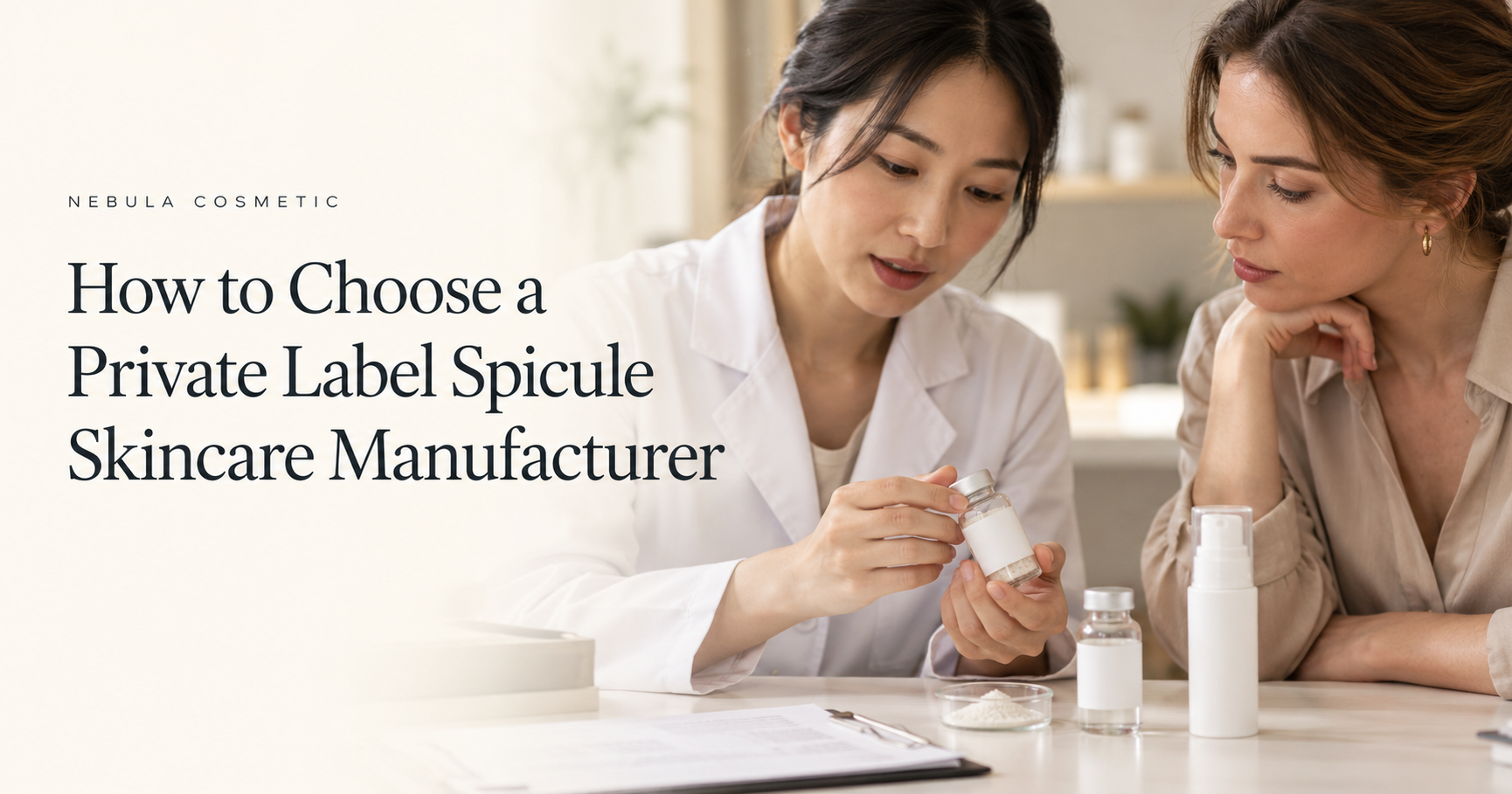
Choose a private label spicule skincare manufacturer by checking how it connects the raw material, finished formula, packaging and intended use. A supplier should be able to explain what it will make, which evidence supports the product and how it will reproduce the approved sample. A large catalog or a strong tingling sensation cannot answer those questions.
For a brand or professional distributor, the decision also involves documentation, commercial terms and support after delivery. A useful partner makes these responsibilities clear before production, so the buyer can assess the whole project rather than just the price per bottle.
At Nebula Cosmetic, we approach this as a finished-product manufacturing discussion. This guide explains what to request at each stage, how to interpret the documents and how to compare shortlisted suppliers on a common basis.
1. Start With A Brief That Defines The Product
Identify The Customer And Use Setting
Tell suppliers whether the product will be applied by professionals or used independently at home. A treatment gel for a salon, a powder-and-liquid kit for a distributor and a retail serum need different preparation, packaging and instruction decisions.
Include the intended market, cosmetic concern and preferred format. If the product will be part of a treatment program, explain which supporting products you expect to offer. The manufacturer needs to understand the role of the formula before discussing concentration or a strength label.
A brief does not need to specify every technical detail. It should make the business requirement clear enough for the supplier to propose a suitable starting formula and identify questions that still need development.
Separate Existing Formulas From Custom Development
Ask whether the quote covers an existing formula with your branding, an adjustment to that formula or a new development. Suppliers use terms such as private label, OEM and ODM differently. The work included matters more than the label attached to the service.
An existing formula may reduce development decisions, but its data still needs to be relevant to your proposed use and pack. Custom work may require more sampling and evaluation. Agree on the extent of customization and how changes will affect cost and timing.
Buyer’s Note: Send the same brief to each shortlisted supplier. Comparable enquiries make it easier to distinguish a real difference in capability from a difference in quoted scope.
2. Confirm Who Will Manufacture The Finished Product
Raw Material Expertise And Formulation Capability Are Different
A spicule raw-material producer may supply useful technical information about source, composition and particle characteristics. That does not automatically establish its ability to formulate, preserve, fill and package your finished cosmetic.
Conversely, a finished-product manufacturer may purchase spicules from a specialist supplier. That can be a workable arrangement if sourcing, specifications and quality responsibilities are clear. There is no requirement for every capable cosmetic factory to extract its own sponge material.
Ask which company develops the formula, which site manufactures and fills it, and whether another party assembles the kit. If you work through a trading or project-management company, establish how it obtains technical answers and controls changes. An intermediary should make the supply chain understandable.
Assess The Team Assigned To Your Project
Factory size alone does not tell you whether your project will receive suitable support. Ask who will answer formulation questions, review the pack and coordinate quality documents. Look for responses tied to the proposed product rather than general statements about capacity.
A focused manufacturer may suit a limited launch if its processes and resources match the work. A larger facility may offer other advantages. The practical test is whether the supplier can meet the agreed requirements consistently and communicate when it cannot.
3. Check The Spicule Material Specification
Ask For Identity And Measurable Characteristics
Request the ingredient identity, source, full composition and relevant material specification. If the ingredient is supplied as a blend, clarify which components accompany the spicules. Hydrolyzed Sponge on an ingredient list does not describe every feature of the purchased material.
Useful questions concern particle dimensions, shape and the methods used to characterize them. Representative microscopic images can support a discussion when their source and scale are clear. A decorative needle illustration cannot replace a material specification.
Ask how the supplier identifies and approves incoming material. You do not need to see every proprietary processing detail to establish whether the proposed grade is defined and traceable.
Put Purity And Count Claims On The Same Basis
A purity percentage may refer to spicule content, silica content or another measured parameter. Ask what the figure means and how it was obtained. Compare suppliers only when the definitions and methods are sufficiently clear.
Spicule counts also need units and context. Counts per gram of raw material, per bottle and per application describe different amounts. A large number cannot establish a better finished product without knowing the composition, dose and application conditions.
Technical Note: Request the meaning, units and method behind a material claim. A number that cannot be explained should not become the basis for selecting a formula.
4. Use A Document Checklist To Compare Suppliers
The following requests can be staged as the project develops. Confidential material may require an appropriate agreement or direct disclosure to a qualified assessor, but the supplier should explain what can be provided and when.
Review area | What to request | What it helps establish |
Manufacturing scope | Legal entity, production site and outsourced steps | Who makes and controls the finished product |
Spicule material | Identity, composition, specification and batch COA | What raw material is proposed |
Finished formula | Formula code, intended use and sample status | Which version is being evaluated |
Product evaluation | Relevant reports and remaining test plan | Which questions have been addressed |
Packaging | Confirmed pack and compatibility information | Whether the presentation suits the formula |
Quality system | Relevant credentials and traceability process | How production and complaints are managed |
Commercial terms | Itemized quote, MOQ and written scope | What the order includes and commits you to |
5. Evaluate The Sample As A Finished Presentation
Agree What The Sample Represents
Ask for the formula code, sample date and relevant development status. Confirm whether the sample uses the intended spicule grade and whether it is a stock formula or a project-specific revision. Keep the written specification alongside the sample.
Use packaging that represents the launch presentation as closely as practical. A formula supplied in a sample jar may dispense differently from a pump or tube. A kit needs both components, their quantities and preparation instructions, rather than a powder sample alone.
Keep comparison conditions consistent and follow the supported directions. Record preparation, dispensing, appearance and the instructed use experience. Product use on people should follow an appropriate evaluation plan; informal feedback does not replace safety assessment or substantiate a broad efficacy claim.
Judge More Than The Sensation
For gels, examine how consistently the product dispenses and whether the supplier has assessed particle distribution. For kits, examine transfer, mixing and usable yield. A product can be awkward to prepare even when its ingredient story is attractive.
Ask what changes the supplier recommends after feedback and why. A technically useful response may involve texture, pack or instructions rather than simply adding more spicules. Stronger prickling is not evidence of superior performance.
Sampling Tip: Keep one approved reference sample and a written record of its formula code and presentation. Future production should be compared with an agreed specification, not memory.
6. Review Finished-Product Testing
Match Each Report To The Proposed Product
A raw-material certificate of analysis, or COA, describes a material batch against its specification. It does not establish the safety, stability or effect of the finished formula. A safety data sheet, or SDS, provides handling information and serves a different purpose again.
For finished-product reports, check the sample identification, formula version, pack, methods and conclusion. Ask whether a change to fragrance, actives, packaging or use conditions affects the relevance of existing results. A report for a similar product can provide background without fully covering yours.
Separate routine release checks from longer-term evaluations. Appearance and microbiological results at release do not alone demonstrate shelf life. A product should have a suitable plan for stability, packaging compatibility and its intended conditions of use.
Understand Preservation And Claim Evidence
Ask how the microbiological protection of the formula has been assessed. ISO 11930 describes evaluation using preservation efficacy testing, microbiological risk assessment or both, with provisions for products assessed as low risk. It is a reference framework, not a universal certificate proving every product has passed.
Claim evidence should address the promised outcome. An ingredient delivery experiment, a consumer questionnaire and an instrumental study answer different questions. If you want to claim an improvement in visible texture, ask which finished-product evaluation supports that wording.
A supplier should distinguish what is already available, what can reasonably be bridged and what needs additional work. Be cautious when a single document is presented as proof of safety, shelf life and every proposed benefit.
7. Verify Manufacturing Quality And Traceability
Read Certificates For Their Actual Scope
ISO 22716 provides guidelines for cosmetic production, control, storage and shipment. If a supplier presents certification, review the legal entity, site, activities, issuing body and validity. Confirm that the relevant manufacturing site is covered rather than assuming that one group company’s certificate covers every location.
Certificates are a starting point for questions. Ask how the factory records batches, controls incoming materials and handles nonconforming product. A video meeting, site visit or suitable audit can help assess those processes according to the scale of the project.
Agree How Changes And Complaints Will Be Managed
Ask how the supplier will notify you of changes to the spicule grade, formulation, process or packaging. The agreement should identify which changes require review and approval before implementation. Reassessment may be needed when a change affects the product or its supporting data.
Also establish how samples are retained and how a batch is traced if a complaint arises. Agree on the information needed for an investigation, the contact person and how affected stock will be handled. A useful quality process extends beyond the shipment date.
8. Clarify Support For The Destination Market
Registration And Notification Are Not Product Approval
In the United States, FDA cosmetic facility registration and product listing do not indicate FDA approval. The FDA also states that it does not issue certificates verifying cosmetic facility registration or product listing. A third-party document should not be represented as an FDA-issued approval certificate.
In the European Union, the European Commission describes CPNP as a cosmetic product notification system. A notification record should be understood in that role; it is not a substitute for the wider product assessment and compliance work applicable to the project.
These examples illustrate why a buyer should identify the target market early. A factory’s export history does not establish that every formula, intended use or label is suitable for every destination.
Define Who Provides Which Documents
Agree who will review the formula, claims and labeling and who will manage any required local assessment or submissions. The manufacturer may provide data while a separate qualified assessor, importer or responsible party performs other work. Put that division in writing.
Confirm how confidential composition information will reach the person who needs it. A supplier can protect its know-how while arranging appropriate disclosure under agreed terms. An unexplained refusal to supply information needed for assessment is a problem to resolve before committing.
Important: Ask what a registration, notification or certificate actually covers. General compliance language should not replace a product-specific plan for your market.
9. Compare MOQ And Total Project Cost
Break The Quotation Into Its Components
Request the formula, filling, primary packaging, carton and other included items separately where practical. Establish whether testing, artwork, samples and professional documentation are included or additional. State the delivery basis and identify which transport or import costs remain outside the quote.
For a kit, confirm the powder and liquid quantities, sets per carton and any supplied tools. For a gel, confirm usable portions under the supported instructions. Price per bottle and price per set are not directly comparable until their scope and intended yield are clear.
Check What Drives The Minimum Order
MOQ may be constrained by the formula batch, filling setup, bottle decoration or printed carton. Ask whether it applies per formula, pack size, artwork or complete kit. A low formula MOQ can still involve a larger packaging purchase.
An established pack may reduce the initial commitment if the supplier already uses it. Ask about actual available options and who owns any unused components. This helps a smaller launch avoid tying up money in packaging that cannot easily be reused.
10. Protect The Approved Scope And Development Work
Clarify Formula Ownership And Exclusivity
Private labeling an existing formula does not automatically give the buyer exclusive rights to it. Ask whether the agreement covers branding only, a customized version, access to specified information or ownership of development work. These are separate commercial decisions.
If exclusivity is offered, define the formula, market, channel, duration and any conditions. The same care applies to artwork, molds and packaging tooling. A verbal promise that a product is unique is difficult to assess without a written scope.
Link The Timeline To Approval Milestones
Ask when samples, artwork, packaging and the final specification must be approved. The production lead time may begin only after these conditions and agreed payments are complete. Confirm where additional testing or material procurement fits.
Agree on the process for revisions and the record that authorizes production. This protects both parties when a project moves from a sample to a commercial batch. A clear milestone plan is more useful than an optimistic delivery date with no assumptions attached.
Procurement Tip: Put the approved formula, packaging, included documents and change process into the order agreement. A detailed quotation is useful only if the production scope matches it.
11. Shortlist Suppliers By The Quality Of Their Answers
Start with a small group that can address the brief. Compare the clarity of their technical responses, relevance of their documents and ability to explain limitations. A supplier that identifies necessary work can be more useful than one promising every claim immediately.
Use sampling and document review to resolve the most important uncertainties before placing the order. Verify what you can independently, and agree how confidential information and outstanding tests will be handled. Move forward when the product specification, responsibilities and commercial terms are concrete.
At Nebula Cosmetic, our professional sponge microneedle collection provides a starting point for discussing formats and private label requirements. Share your intended market, channel and product concept so the discussion can focus on a defined project. The right manufacturing relationship gives both parties a clear understanding of what will be made, how it will be evaluated and how it will be supplied again.
You May Also Like
Develop Your Skincare Products
Looking to launch your own skincare line? Our experienced team can support you through every stage of the development process. From custom formulation and ingredient selection to packaging and full-scale manufacturing, we provide complete OEM and private label solutions tailored to your brand.
