
Spicule Gel vs Powder-and-Activator Kits | How to Choose
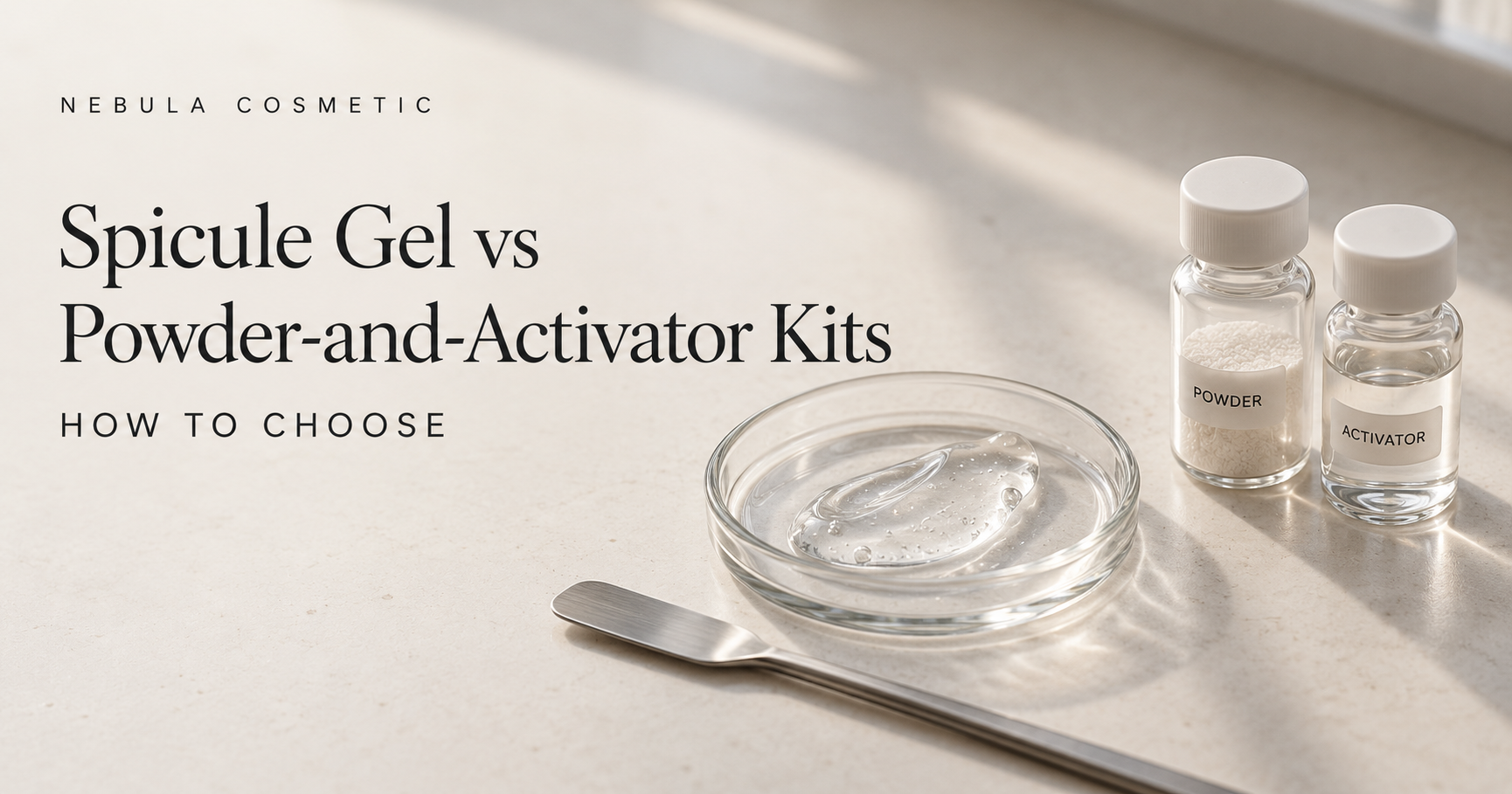
Choose a spicule gel when your priority is a ready-to-apply product with fewer preparation steps. Consider a powder-and-activator kit when your professional service benefits from a defined mixing stage and components supplied together. In both cases, the decision should follow the formula, packaging and intended method of use. The format alone does not tell you which product is stronger, safer or more effective.
For a brand or distributor, this choice also changes purchasing and support. A gel involves one finished formula and its dispensing pack. A kit involves at least two components, their matching quantities and instructions for preparing the mixture. At Nebula Cosmetic, we view those as different product development briefs, each with practical advantages and questions to resolve.
This guide focuses on topical spicule products for professional skincare and private label development. It explains what to compare before requesting samples, how to assess the finished presentation and where each format can fit in a range.
1. What Each Product Format Contains
A Spicule Gel Is Supplied In Its Application Base
A spicule gel contains the spicule material within a prepared gel base. The practitioner dispenses the specified amount and follows the product instructions. Depending on the brief, the base may contain humectants, skin-conditioning ingredients or other cosmetic actives.
A ready-to-apply gel removes a separate mixing stage at the point of use. It still needs a defined dose and handling method. A product in a tube, pump or jar can be convenient only if that container dispenses the formula reliably and suits the intended setting.
A Kit Keeps The Powder And Liquid Separate Until Preparation
A powder-and-activator kit supplies the powder and a designated liquid as separate components. They are mixed according to the manufacturer’s instructions before application. The powder may be a blend rather than pure spicules, while the liquid may be a formulated essence or gel rather than plain water.
“Activator” is a useful product description, but it does not establish that a chemical activation occurs. In some systems, the liquid primarily wets and disperses the powder or provides a suitable application base. Ask the manufacturer what the mixing stage actually does in the proposed formula.
Manufacturer’s Note: Confirm the full composition of both components. A powder weight and a liquid volume do not tell you how much spicule material is present in the prepared treatment.
2. Comparing The Formats At A Glance
Use this table to identify development priorities. Final suitability depends on the specific formula, package and intended use.
Consideration | Spicule gel | Powder and activator kit |
Preparation | Dispense the prepared formula | Combine designated components before use |
Consistency checks | Particle distribution and dispensing | Component ratio and uniform mixing |
Stability checks | Formula and pack through storage and use | Each component and the prepared mixture |
Packaging | One formula and dispensing presentation | Matched powder and liquid containers |
Staff tasks | Dose and handle the finished product | Transfer, mix and apply as instructed |
Cost comparison | Usable applications per pack | Complete applications per kit |
Typical reason to shortlist | Simpler preparation | A defined preparation stage within a professional service |
3. Preparation And Consistency During An Appointment
A Gel Reduces Preparation Tasks
For a professional team, a gel can make preparation easier to organize. Staff dispense a finished product instead of opening two components, measuring and mixing. That may suit an institution that wants a straightforward procedure across several treatment rooms.
The potential time saving should be checked in practice. A gel that is difficult to dispense or leaves substantial material in the pack can create its own delays. Test the actual presentation rather than evaluating a sample supplied in a different container.
A multi-use pack also requires a clear method for removing product and keeping the container clean. One package serving several appointments should not lead to inconsistent portions or repeated contact with used tools.
A Kit Makes Mixing Part Of The Procedure
A kit can organize preparation around a defined set of components. Where the pack is intended for one application, the matching containers can make it clear which powder and liquid belong together. This can be useful for a distributor supplying a structured professional program.
The trade-off is an additional task that staff must perform correctly. Check how easily the powder transfers, whether the mixing vessel is suitable and whether dry material remains in the container. A powder that looks fully incorporated at first glance may still need closer evaluation for uniformity.
The instructions should describe the intended consistency and when the prepared mixture should be used. Any mixing time or waiting period needs to come from that product’s development work, rather than from another brand’s protocol.
Development Tip: Watch a practitioner prepare the sample using only the proposed pack and instructions. Record where they hesitate, need another tool or leave material behind.
4. Dose And Strength Require A Common Basis
Compare The Amount Delivered Per Application
A percentage in a gel and the weight of powder in a kit are different pieces of information. To compare them, first establish the composition of the raw material, its amount in the formula and the intended finished-product dose.
For a kit, include the full mixing ratio. Adding more liquid changes the prepared mixture’s concentration and flow. It does not change the total amount of spicule material in the powder portion. How much of the mixture is actually applied is another part of the comparison.
For a gel, confirm the amount dispensed per application and whether the spicules remain evenly distributed. A reliable formula and a reliable dispenser need to work together. Looking at the ingredient list or a concentration claim alone will miss those details.
Powder Does Not Automatically Mean A Stronger Treatment
Either format can be developed for different positioning, subject to suitable evaluation. A kit is not inherently professional-strength, and a gel is not inherently mild. Particle characteristics, formulation and the application method all need consideration.
Prickling is also a poor way to rank samples. Ask evaluators to record the experience under defined conditions, then assess it alongside the intended cosmetic outcome and tolerance. A stronger sensation should not become the target simply because it is easy to notice.
Buyer’s Note: Request a comparison based on the intended application dose and method. Package size, powder weight and sensation alone cannot establish relative treatment strength.
5. Stability Before And After Opening
A Gel Must Remain Fit For Use Throughout Storage
The gel base needs to maintain suitable appearance, flow and particle distribution over the proposed shelf life. The manufacturer should investigate changes such as settling, separation or altered dispensing. Supplier technical guidance for one Hydrolyzed Sponge grade specifically highlights suspension in a gel network and gentle handling; those recommendations concern that grade and need assessment in the final formula.
Packaging is part of this work. Evaluate the formula in the proposed container and consider expected storage and transport conditions. Cosmetics Europe guidance identifies physical, chemical and microbiological stability, together with compatibility between contents and container, as relevant parts of a stability program.
Separate Components Create Additional Checkpoints
A kit allows ingredients to remain apart before preparation. That can be useful when a specific formulation has a demonstrated reason for separation. It does not establish a longer shelf life or a better result without supporting data.
The powder, liquid and prepared mixture each introduce questions. The unopened powder needs suitable protection against moisture. The liquid needs appropriate stability and microbiological assessment. The mixture needs evaluation for the conditions and period in which it will be handled and applied.
A dry-looking powder is not necessarily freeze-dried. If a brand wants to describe a component as lyophilized, it should confirm the process and supporting information with the manufacturer. Sponge powder and a freeze-dried active blend are different descriptions.
Define What Happens After Preparation
The expiry of unopened components does not provide a storage period for the mixed product. The instructions should clearly state whether it is intended for immediate use and what to do with any remainder. Do not promise that a mixture can be saved for another appointment without evaluation supporting that practice.
6. Preservation And Hygiene
Assess The Formula And The Way It Will Be Used
Water-containing gels and kit liquids need appropriate microbiological protection. A low-water powder may present a different risk profile, but dry packaging alone does not demonstrate sterility. The assessment should consider the components, containers and intended handling conditions.
ISO 11930 describes evaluation of a cosmetic product’s antimicrobial protection using preservation efficacy testing, microbiological risk assessment or both. It includes distinctions for products assessed as low risk; the relevant approach should be selected by qualified personnel for the actual product.
Mixing Introduces Handling Decisions
The kit instructions should identify the supplied or specified liquid. Replacing it with tap water, a different serum or another brand’s solution changes the mixture and invalidates assumptions made for the original system. Staff should know which tools are needed and how to handle them appropriately.
The same care applies to gels. The FDA identifies inadequate packaging, ineffective preservation, storage and consumer handling among potential routes of cosmetic contamination. Convenience should therefore be evaluated together with the method of dispensing and keeping the pack clean.
Important: Use the designated components in the stated ratio. A kit evaluated with its matching liquid has not automatically been evaluated with other liquids or skincare products.
7. Packaging Should Support The Procedure
Check Gel Dispensing Through The Life Of The Pack
A pump may offer convenient portioning, but it still needs to work with the formula and particles. A tube or jar presents different handling questions. Evaluate the actual proposed pack for dose consistency, ease of use and the amount left behind near the end.
If the product is supplied in a multi-use presentation, confirm how it should be stored and handled after opening. An airless pack can be considered, but the term airless does not remove the need for compatibility or use assessment.
Check The Complete Kit As One Presentation
For a kit, the powder closure needs to protect its contents, and the liquid container must dispense the required quantity. Clear component identification reduces the chance of using the wrong product. If several kits look similar, a short product name or code can be more useful than relying only on color.
The outer carton should keep the components organized during transport. Check whether a practitioner can open the kit, identify the sequence and prepare it without searching elsewhere for essential directions. A set that photographs well but is awkward to use needs further work.
For both formats, approve the formula and packaging together. A later change to the container, opening or dispenser may require additional checks before production.
8. Comparing Cost And Procurement
Calculate Cost Per Completed Application
A meaningful cost comparison starts with the confirmed quantity used per appointment. For a multi-use gel, divide the usable content by the application dose, allowing for dispensing losses. For a kit, establish how many complete applications the presentation is actually designed to provide.
Then include the items needed to deliver the service: mixing tools where relevant, preparation time, unused remainder and any specified consumables. A lower purchase price per bottle may not produce a lower cost per appointment.
For illustration, a nominal 100 g pack might suggest 20 applications at 5 g each. If only 90 g can be used under the defined dispensing process, the calculation becomes 18 applications. Those figures are hypothetical; the point is to measure usable yield rather than assume the full labeled content becomes treatment portions.
Ask For MOQ By Component And Customization Level
A gel may involve fewer packaging components than a two-part kit. A kit, however, may be available in an established presentation that makes ordering straightforward. The supplier’s existing setup matters more than the number of containers alone.
Request a breakdown for the formula, primary packaging, outer carton and artwork. Check whether minimum quantities apply to finished sets or to individual components. A customized bottle or printed carton can create a larger commitment than the formula itself.
For kits, also ask how replenishment is managed. Powder and liquid quantities need to stay aligned, and replacements should be traceable to the correct system. Confirm what happens if one component’s lead time changes.
Procurement Tip: Compare quotes on the same scope: usable applications, included components and customization. A price per gel bottle and a price per kit are not directly comparable.
9. Which Format Fits Your Channel
When To Shortlist A Gel
A gel is worth considering when the customer values fewer preparation steps, has a clear dispensing method and wants a product that fits an established professional routine. It may also provide a starting format for a retail brief, but home use needs its own evaluation and directions.
For a first private label project, an existing gel formula and compatible stock pack can simplify the number of decisions. That advantage depends on what the manufacturer already has available. Ask for the actual options before assuming development will be faster.
When To Shortlist A Kit
A powder-and-activator kit is worth considering when the business wants preparation organized around a complete set and can support staff training. A defined kit presentation can help an institution explain the components of a professional service to its team.
It may also suit a distributor building a treatment program with consistent supply and documentation. The additional preparation and inventory responsibilities need to be practical for the customers receiving it. Fresh mixing should serve the formula or procedure, rather than exist only as a premium visual cue.
Start With One Well-Defined Use Case
There is no requirement to launch both formats at once. Choose the customer and procedure you can support well, then develop the format around that brief. A later addition should offer a clear operational or formulation difference rather than duplicate the first product in another package.
Evaluating Samples Before Placing An Order
Request samples in packaging that represents the intended launch as closely as practical. Agree on a written evaluation covering preparation, dispensing, appearance and the instructed use experience. A hands-on review helps assess usability; it does not replace the manufacturer’s safety, stability or claim evaluation.
For gel samples, record the dose delivered and how easily the container works. For kits, record transfer, mixing and the amount actually available after preparation. Ask what has been tested in the finished presentation and what remains to be confirmed.
At Nebula Cosmetic, our professional sponge microneedle collection provides a starting point for comparing product options and customization. Share your target market, customer type and preferred presentation so the discussion can focus on a practical formula and package. The right choice is the one your customer can prepare, apply and reorder consistently, with evidence and instructions appropriate to its intended use.
You May Also Like
Develop Your Skincare Products
Looking to launch your own skincare line? Our experienced team can support you through every stage of the development process. From custom formulation and ingredient selection to packaging and full-scale manufacturing, we provide complete OEM and private label solutions tailored to your brand.
