
Copper Peptide Lyophilized Powder | Brand Development Guide
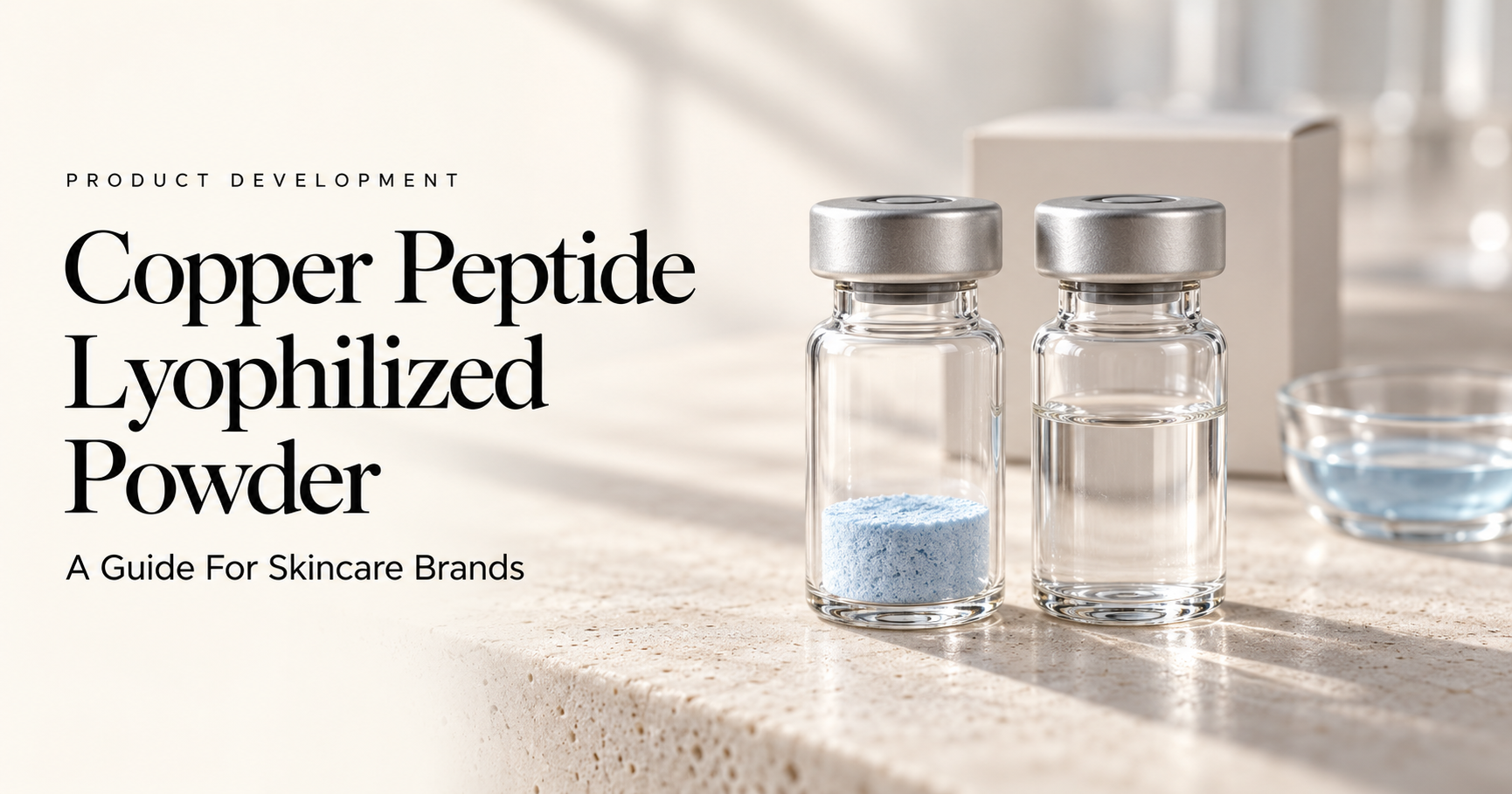
Copper peptide lyophilized powder can be developed as a freshly mixed cosmetic product for a professional skincare collection. For a brand, the development task is to connect the ingredient concept with a useful product role, a practical powder-and-activator system and evidence supporting the finished formula.
A blue appearance and a technical presentation can help customers recognize a product, but neither establishes its copper peptide content or cosmetic performance. Successful development needs clear specifications for what is supplied, how it is prepared and what customers can reasonably expect from using it.
This guide explains how skincare brands and professional distributors can brief, sample and evaluate a topical copper peptide freeze-dried product. It covers ingredient identity, formulation, packaging, testing and the decisions to make with an OEM manufacturer.
1. Understand The Ingredient And Define The Product Role
What Is Copper Peptide Lyophilized Powder?
In skincare, GHK-Cu refers to a copper complex of the tripeptide glycyl-histidyl-lysine. Copper Tripeptide-1 is a cosmetic ingredient name used in this area; related peptide derivatives and metal salts have distinct identities. The Cosmetic Ingredient Review assessment discusses these ingredients primarily as skin-conditioning agents. [1]
A copper peptide lyophilized skincare product combines the ingredient concept with a freeze-dried presentation. The dry component is paired with a specified liquid, which the user adds before topical application. The resulting formula includes everything contributed by both components.
The powder may therefore contain supporting formulation materials as well as the featured peptide. Ask the manufacturer to identify the supplied copper peptide material, its composition and its amount in the final mixture. The product name alone is not a complete specification.
Choose A Clear Place In The Skincare Collection
Define the desired cosmetic outcome before selecting the ingredient combination. A brand may explore a concept focused on smoother-looking skin, visible firmness or a hydrated appearance. The proposed wording should guide the finished-product evaluation rather than be treated as a result already established by the ingredient name.
For a salon range, describe when the product would be prepared, who would apply it and how it fits the existing cosmetic facial routine. For homecare, explain why customers would choose a mixing step and how they will understand the instructions.
Nebula’s Copper Peptide Lyophilized Powder is presented as a professional topical concept within our freeze-dried collection. A private label project should establish its own final specifications, supported claims and intended use.
Manufacturer’s Note: Start with one defined customer and application. “A freshly mixed facial product for professional salons” gives development a clearer direction than a long list of unrelated skin concerns.
2. Design The Powder And Activator As One Formula
Establish Why The Product Should Be Freeze-Dried
Ask what the dry format contributes to this particular project. Possible reasons to investigate include ingredient stability management, separation of components before use or a professional preparation experience. Each reason needs to be assessed against the extra development and packaging involved.
Avoid describing GHK-Cu as universally unstable in water. A published preformulation study reported stability in selected aqueous and buffered conditions, while also identifying degradation under certain stress conditions and differences in compatibility with formulation components. These laboratory findings concern the systems studied; they do not assign a shelf life to a commercial cosmetic.
General lyophilization research also shows that freezing and drying can introduce stresses. Formula design, processing conditions and packaging contribute to the quality of the dried product. Pharmaceutical studies provide useful principles but do not demonstrate the efficacy of a finished skincare formula.
Manufacturer’s Note: Ask the formulator to explain the reason for freeze-drying your proposed composition. A credible product story should match the development rationale and available evaluation results.
Specify Ingredient Content And The Mixing Ratio
Separate three quantities in the brief: the total dry fill, the amount of the supplied copper peptide material and the final volume after mixing. Clarify whether an ingredient percentage refers to a raw-material blend or to the named ingredient itself.
For illustration, 30 mg of total dried material mixed with 3 mL of activator gives a nominal total dry-solids loading of 10 mg/mL, before allowing for any volume change. It does not identify the copper peptide concentration. This calculation is an explanation of quantities, not a recommended formula or application amount.
Agree how the final mixture will be specified and which analytical information the supplier can provide. If a concentration is proposed for the label, confirm its meaning before approving the artwork. Avoid comparing two products using numbers that describe different things.
Develop The Activator And Supporting Ingredients
The activator contributes to the applied formula, including its texture, pH and sensory experience. Ask the development team how the chosen liquid works with the dry component and what should happen when the specified quantities are combined.
A brief may include moisturization or comfort goals alongside a peptide concept. Discuss the purpose of each supporting ingredient and whether it belongs in the powder or liquid. Adding more named ingredients increases the questions to resolve during development; it does not establish a more effective product.
Select the finished mixture’s pH and compatibility targets from product-specific development work. Do not borrow a universal pH range or assume that another brand’s acid, antioxidant or peptide formula can serve as your activator. The published preformulation research illustrates why composition and stress conditions deserve attention.
Manufacturer’s Note: Evaluate the complete mixed formula before approving a component change. A new activator can change the product customers apply even when the powder vial remains identical.
3. Make The Presentation And Application Practical
Set A Realistic Color And Appearance Specification
Treat color as a characteristic to define and monitor, rather than a measurement of ingredient content. A finished product’s appearance can reflect its composition, concentration and packaging. Visual comparison between photographs is particularly unreliable when lighting and glass differ.
Ask for reference samples showing the agreed dry appearance and the appearance after mixing. If the product is expected to have a pale blue tone, specify an acceptable range and assess it under consistent conditions. Investigate unexplained changes rather than accepting or rejecting a batch from an informal photograph alone.
Avoid adding color simply to make a formula look more concentrated. Discuss any colorant as a separate formulation and positioning decision, with appropriate ingredient disclosure and target-market review.
Select A Kit That Matches The Intended Portion
Design the powder vial, activator bottle and transfer method together. A paired set should make it easy to identify the components and combine the intended quantities. Define whether one pair is meant for one application or another evaluated pattern of use.
For professional sampling, observe staff preparing the kit during a realistic facial sequence. Review opening, transferring, mixing and dispensing. Record awkward closures, unclear steps and product that remains inaccessible inside the pack.
| Development Choice | What The Brand Should Define | What To Review In Samples |
| Application Setting | Professional facial or specified homecare use | Whether the intended user can prepare the kit |
| Product Portion | Amount needed for the supported application | Dispensing and avoidable remainder |
| Component Pairing | Powder fill and matched activator quantity | Correct identification and transfer |
| Mixed Texture | Desired spreadability and finish | Application within the cosmetic routine |
| Carton Format | Number of matched pairs per retail unit | Clear contents and practical presentation |
| Instructions | Preparation, application and disposal steps | Understanding without extra explanation |
Define Use After Mixing And Routine Compatibility
Establish the period of use after mixing for the finished product. Nebula’s current copper peptide product page instructs immediate use and disposal of unused mixture; a different private label system needs its own supported instructions rather than assuming a longer period.
FDA identifies ingredients, manufacturing, preservation, packaging and handling as possible sources of cosmetic contamination. A dry component does not remove the need to evaluate the complete system. [5]
For a professional routine, confirm the planned sequence with the finished formula. Do not equate professional presentation with suitability for injection, needling or use on damaged skin. This guide concerns topical cosmetic development; other applications need separate assessment.
Manufacturer’s Note: Approve the application instructions alongside the packaging. The portion, preparation method and disposal guidance should describe the same product experience.
4. Build A Verification Plan Before Making Claims
Review The Dry Product And The Mixed Formula
Ask the manufacturer to distinguish development evaluations from routine batch-release checks. Define which characteristics will be assessed before launch and which specifications will apply to each order.
For the dry component, discuss appearance, fill consistency, moisture-related quality and protection by the container. Lyophilized-product research identifies residual moisture, cake characteristics and reconstitution among relevant development considerations; appropriate methods and limits must be selected for the actual system. [3]
For the final mixture, agree relevant physical, chemical and microbiological evaluations. Ask how mixing behavior, ingredient content where relevant, packaging compatibility and the intended use period will be reviewed. A visual check alone cannot establish every characteristic.
| Verification Area | Example Development Question | Intended Decision |
| Ingredient Identity | What material is supplied and how is it specified? | Clear composition and supplier requirements |
| Dry Product Quality | Which appearance and moisture-related limits apply? | Acceptable dry-component quality |
| Mixing Behavior | What should happen with the matched activator? | Practical preparation instructions |
| Storage And Packaging | What supports storage conditions and protection? | Appropriate pack and shelf-life proposal |
| Microbiological Safety | How are both components and use after mixing assessed? | Suitable safety and handling instructions |
| Cosmetic Performance | Does the finished product support the intended wording? | Claims appropriate to available evidence |
Separate Ingredient Research From Finished-Product Results
An ingredient paper can explain why a material is interesting to investigate. It cannot automatically establish that a particular powder-and-activator product improves wrinkles, firmness or another measured outcome.
Translate each proposed claim into an evaluation question. If the brand intends to communicate improved hydration, agree how the finished product will be evaluated for that outcome. For visible appearance claims, define the population, use pattern and assessment approach with the testing provider.
The CIR assessment concerns ingredient safety under the practices and concentrations reviewed. It is not a substitute for assessing a new finished product or evidence that a proposed claim has been demonstrated.
Connect Shelf Life To The Actual Product
Ask which evidence supports the proposed storage conditions and unopened shelf life. Confirm that the formula version and packaging in the supporting work match the product being approved, and identify any remaining studies.
Treat storage before mixing and the period after mixing as separate questions. Avoid importing a multi-year shelf life, refrigeration instruction or use period from an unrelated kit. Keep the development record clear about what is supported, what is provisional and what must be completed before launch.
Manufacturer’s Note: Write the intended claim before commissioning performance work. This helps the testing provider assess the relevant question and prevents a useful result from being stretched beyond its scope.
5. Turn The Concept Into A Focused OEM Project
Prepare A Brief That Can Guide Sampling
Send the manufacturer a concise description of the target market, sales channel and intended cosmetic routine. Identify the product’s role within your range and the experience you want after mixing. Include estimated quantities and the preferred number of pairs per carton.
Useful points to resolve early include:
- The supplied copper peptide material and how its quantity is expressed.
- The purpose and composition direction of the matched activator.
- The intended application amount and use period after mixing.
- Color, texture and packaging expectations.
- The proposed cosmetic claims and available supporting work.
- Sampling stages, test responsibilities and production approval criteria.
Keep feedback linked to sample codes and versions. If an early sample demonstrates texture only, record that limitation. Later approval should cover the agreed formula, component quantities, closures, artwork and kit configuration.
Review Costs And Commercial Readiness
Ask for a quotation that defines the order unit. One powder vial plus one activator may be one pair, while a carton can contain several pairs. Confirm how the formula, printing and packaging minimums affect the actual purchase quantity.
Compare the cost of the complete usable product, including accessories, assembly and agreed testing. Establish who supplies instructions, technical documents and product photographs. For professional distributors, also discuss preparation guidance that downstream accounts can understand consistently.
Plan the first release around a configuration you can explain and support. Additional ingredients, fill sizes or carton variants can be considered after the initial product has been evaluated and you have meaningful customer feedback.
Manufacturer’s Note: Request a sample plan and a quotation based on the same configuration. Formula version, activator quantity, vial count and evaluation scope should remain consistent across both records.
Discuss Your Copper Peptide Product With Nebula
Nebula Cosmetic supports private label and OEM discussions for topical copper peptide lyophilized skincare. We can review ingredient direction, matched activators, texture after mixing and packaging around your intended market and professional or retail channel.
Explore the Copper Peptide Lyophilized Powder Product Concept and our broader Lyophilized Powder OEM And Private Label Solutions. For a project discussion, send your intended customer, desired cosmetic benefits and preferred kit format through Nebula’s Product Consultation.
Frequently Asked Questions
Is Copper Tripeptide-1 The Same As Every Copper Peptide?
“Copper peptide” is a broad description. Confirm the cosmetic ingredient name, supplied material and specifications rather than assuming every related ingredient or blend is interchangeable.
Does A Darker Blue Product Contain More Copper Peptide?
Color alone is not an assay. Use the product composition, specifications and appropriate analytical information to understand content. Photographs are unsuitable for concentration comparisons.
Does Freeze-Drying Automatically Make GHK-Cu More Effective?
No. The process and formula need evaluation for the intended product. Better cosmetic results require supporting finished-product evidence, including a suitable comparison if superiority is claimed.
Can Customers Mix The Powder With Any Serum?
Use the specified activator and instructions. An unrelated serum changes the composition and preparation conditions of the product that was developed and evaluated.
How Long Can Copper Peptide Powder Be Used After Mixing?
Follow the instructions established for that particular system. Nebula’s current professional product concept specifies immediate use and disposal of the remainder. Other configurations need their own evaluation. [4]
Can Copper Peptide Lyophilized Skincare Be Developed For Homecare?
It can be explored as a separate development brief. Assess the complete formula, packaging, instructions and intended user rather than assuming a professional kit is automatically suitable for home use.
You May Also Like
Develop Your Skincare Products
Looking to launch your own skincare line? Our experienced team can support you through every stage of the development process. From custom formulation and ingredient selection to packaging and full-scale manufacturing, we provide complete OEM and private label solutions tailored to your brand.
