
How To Choose A Lyophilized Powder Manufacturer
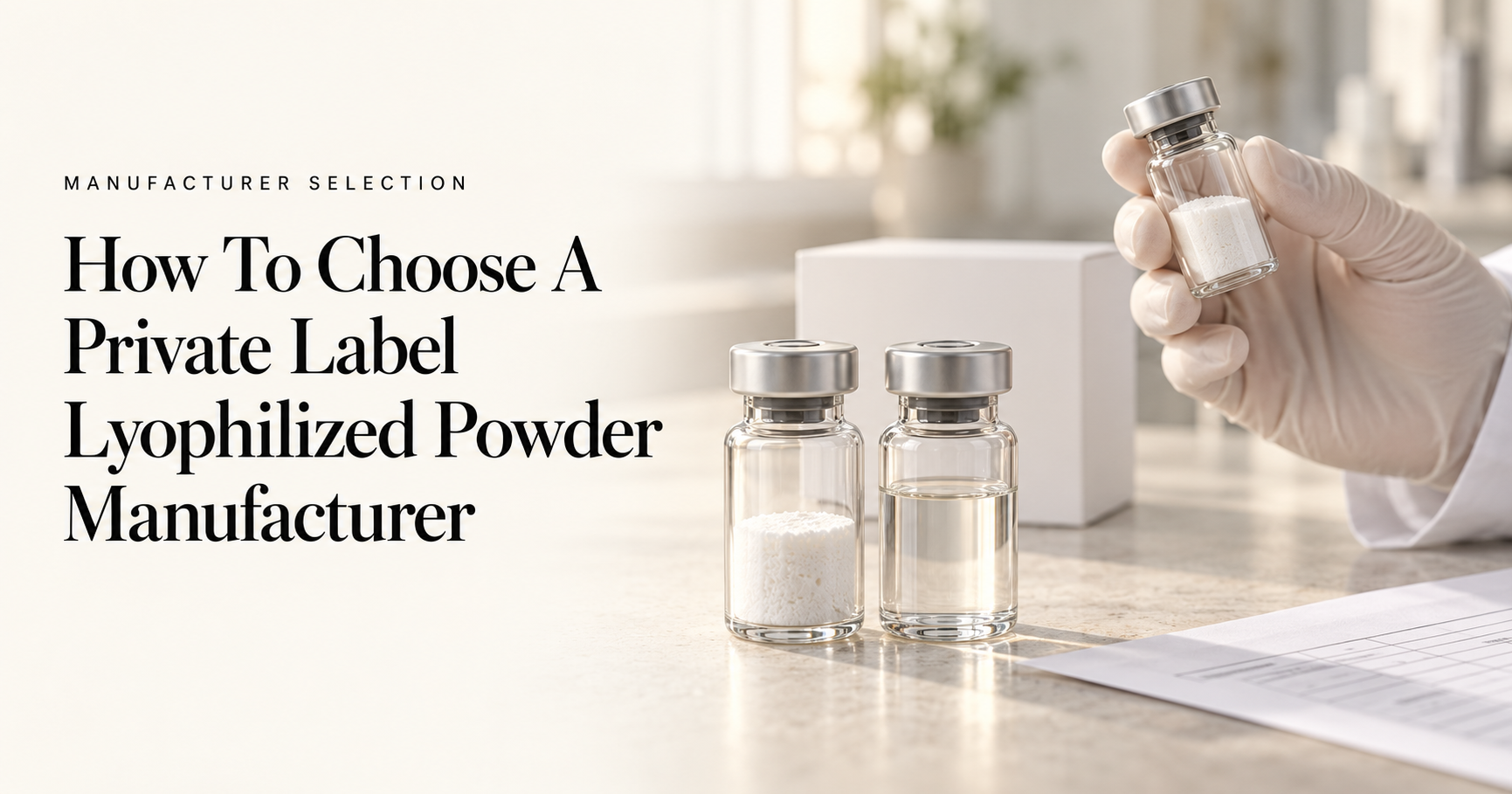
Choose a private label lyophilized powder manufacturer by evaluating the complete product system: the dry formula, its activator, the packaging and the evidence supporting how customers will use it. A sample vial and an attractive ingredient list are useful starting points, but they do not answer every question involved in launching a repeatable commercial product.
For skincare brands, professional distributors and salon or spa businesses, a suitable partner should turn a product concept into a clear development plan. That includes explaining what is already established, what needs additional work and which decisions affect cost or timing.
This guide sets out a practical selection process for topical cosmetic freeze-dried skincare. It covers the questions to ask before sampling, the documents to review and the commercial details to confirm before placing an order.
1. Define Your Product Brief Before Comparing Suppliers
Identify The Customer And Application Setting
Start by describing who will use the product and where preparation will happen. A therapist mixing a kit during a professional facial has different needs from a customer opening it at home. An importer supplying independent salons may also need instructions that staff can explain consistently across multiple accounts.
Specify the intended cosmetic benefits, application setting and customer expectations. For example, a professional skincare line might prioritize a comfortable application, straightforward preparation and a portion suited to one appointment. A homecare concept might prioritize easy opening, clear component identification and simple storage instructions.
Keep the first brief focused. One well-defined use case gives manufacturers a basis for recommending formulas and packaging. Asking for several ingredients, multiple kit sizes and different channels at once can make initial quotations difficult to compare.
Clarify Private Label And Custom Development
Suppliers use “private label,” “OEM” and “ODM” differently. Ask what each option means for the actual project. It might involve branding an established formula, modifying an existing system or developing a new powder-and-activator combination.
Confirm which elements can change and what those changes trigger. A different activator, vial size or mixing ratio may require more evaluation than a carton redesign. An established formula can offer a useful starting point, but its supporting information should still match the product you intend to sell.
Our Lyophilized Powder OEM And Private Label Manufacturing page introduces available product directions and the main areas of customization.
Manufacturer’s Note: Send the same brief to every shortlisted supplier. Include your target market, customer, application setting and expected kit configuration so recommendations and quotations address comparable needs.
2. Assess The Complete Formulation And Manufacturing System
Evaluate The Powder And Activator Together
Ask the manufacturer to explain the role of both components. Which ingredients belong in the powder, what does the activator contribute and what should the finished mixture feel like? The discussion should reach the product customers apply, rather than stop at the appearance of the dry cake.
Distinguish total dry fill from the amount of a highlighted ingredient. Ask whether a stated quantity refers to the whole powder, a supplied ingredient blend or the named ingredient itself. Record the activator volume and mixing instructions alongside that information.
For a Copper Peptide Lyophilized Powder or Oligopeptide Lyophilized Powder concept, use the ingredient name to start the conversation, then request a product-specific proposal covering composition, presentation and intended use.
Manufacturer’s Note: Approve a matched powder-and-activator system. If one component changes, ask the development team which previous results remain relevant and which evaluations need updating.
Ask How Freeze-Drying Supports The Formula
Lyophilization involves freezing, primary drying and secondary drying. Its purpose and operating conditions need to suit the material being processed. FDA’s pharmaceutical inspection guide describes these stages and the importance of formulation, process control and finished-product evaluation. It provides background principles rather than a cosmetic manufacturing specification.
Ask why the proposed cosmetic formula uses this process and which quality characteristics the manufacturer monitors. Research on lyophilized proteins identifies cake appearance, residual moisture and reconstitution behavior among relevant considerations, while also describing stresses introduced by freezing and drying. These findings do not establish the efficacy of a cosmetic product.
The buyer’s task is to obtain an understandable explanation of the proposed controls and their relevance. A supplier should be able to discuss its approach without sharing confidential process settings or another customer’s formula.
Confirm Who Performs Each Manufacturing Step
Clarify where formulation, filling, freeze-drying, activator production, assembly and final release take place. Ask which activities are performed directly and which involve external partners. Record who coordinates specifications, reviews results and authorizes shipment.
A production partner can be part of a workable arrangement when responsibilities are transparent. What matters during selection is whether your supplier can demonstrate control of the agreed product and resolve questions across the production chain.
Use a factory visit, live video review or technical meeting to follow one proposed product through those stages. Ask how a change from a development sample to a commercial batch will be documented, and how you will be informed if a component or production location changes.
Manufacturer’s Note: Request a simple responsibility map. Knowing who makes, tests, assembles and releases the kit is more useful than relying on a general statement that everything is handled “in-house.”
2. Review Quality Evidence And Supporting Documents
Match Reports To The Product Being Quoted
Request a list of available documents and identify which belong to raw materials, the manufacturing facility or the finished product. A raw-material certificate, a factory audit and a finished-product test report answer different questions.
Check the product name or code, formula version, packaging, dates and test scope. Ask whether the report covers an established base formula or the exact customized product. Where work remains outstanding, agree the plan and cost before treating it as included.
A certificate of analysis can report selected batch characteristics; it should not be read as proof of every safety, stability or performance claim. Ask the supplier to explain which specifications apply to routine release and which evaluations belong to product development.
| Review Area | Information To Request | Decision It Supports |
| Product Identity | Formula code, component list and proposed pack | Whether records match your intended product |
| Routine Release | Specifications and a sample batch report | What will be checked before shipment |
| Storage Stability | Study scope, conditions and relevant results | What supports proposed storage and shelf life |
| Use After Mixing | Evaluation plan and application instructions | Whether the intended use period is supported |
| Cosmetic Claims | Finished-product evidence relevant to the wording | Which benefits can be communicated responsibly |
| Traceability | Component and finished-kit batch identification | How a supplied kit can be investigated |
Discuss Microbiological Safety And Handling
FDA identifies several potential sources of cosmetic contamination, including ingredients, manufacturing conditions, inadequate preservation, packaging and consumer handling. Dry presentation alone does not resolve all of these issues.
Ask how the safety assessment addresses the powder, the liquid activator and the product after mixing. Agree the intended application pattern and the testing needed for that system, including preservative efficacy or in-use evaluation where appropriate. Do not assume a single-use presentation or a “preservative-free” description eliminates the need for assessment.
The label’s use period after mixing should come from the finished-product evaluation. Ask for the basis of that instruction and ensure the kit quantity supports it. A sales conversation should not substitute a universal storage period for product-specific information.
Verify Facility Claims And Target-Market Support
ISO 22716 provides guidelines for cosmetic production, control, storage and shipment. It is useful context when reviewing manufacturing quality arrangements, but the standard’s scope does not establish an individual formula’s efficacy.
If a supplier presents a certificate, check the legal entity, covered location, scope, issuer and validity. Separately establish which documents your target-market reviewer needs and who will prepare or supply them.
For U.S. projects, distinguish registration and listing from approval. FDA states that cosmetic facility registration and product listing do not indicate FDA approval, and that it does not issue certificates verifying compliance with those activities.
Manufacturer’s Note: Build a document list for your specific project, with an owner and delivery stage for each item. This helps prevent a general promise of “export support” from leaving important responsibilities unresolved.
3. Validate Samples And Packaging As One Product
Set Acceptance Criteria Before Reviewing Samples
Before samples arrive, agree what the review is intended to establish. An early laboratory sample may demonstrate a concept, while a later sample should represent the proposed formula and packaging more closely. Identify those differences so nobody mistakes a development sample for production approval.
Record observations against shared criteria: dry appearance, preparation method, resulting texture, dispensing and compatibility with the intended cosmetic routine. Ask the manufacturer to specify acceptable appearance and mixing behavior for that product rather than judging every system against an arbitrary requirement for perfect clarity.
Document feedback with the sample code, date and a clear description of the issue. “Too sticky after application” gives the development team a more useful revision target than “make it more premium.” Keep a record of what changes and what needs to be reviewed again.
Test The Actual Mixing And Dispensing Experience
Evaluate closures, transfer accessories and instructions with the people expected to use them. For a salon concept, observe a therapist preparing the kit during a realistic appointment sequence. For homecare, observe first-time users without explaining each step for them.
Can they identify the correct components, transfer the intended liquid and dispense the agreed amount? Are opening steps awkward? Is the distinction between vial capacity and liquid fill clear? Does any usable product remain inaccessible in the packaging?
Treat these observations as packaging feedback. A simple adjustment to the opening method or instructions may solve a problem more effectively than changing the formula. Ask which modifications can be introduced without invalidating previously reviewed results.
Confirm The Approved Production Reference
Before commercial production, identify the approved formula version, component specifications, artwork and pack configuration. Keep an agreed reference sample or other documented approval record, with a clear description of anything that remains conditional.
Include the carton’s meaning of a “set” or “pair.” One powder vial plus one activator may form one pair, while a retail carton may contain several pairs. The quotation, order confirmation and label should use consistent units.
Discuss transport protection and the checks needed for your distribution route. Confirm how the supplier will handle leaks, breakage, incorrect assembly or a difference between approved samples and delivered stock.
Manufacturer’s Note: Complete a realistic preparation trial before approving packaging quantities. A visually attractive kit still needs to open, mix and dispense reliably in the customer’s actual setting.
3. Compare Commercial Terms And Choose Your Partner
Compare Quotations Using The Same Assumptions
Ask each supplier to quote a defined configuration and identify exclusions. Compare the number of powder vials, activator bottles, accessories and cartons, along with the agreed customization and documentation work.
For professional products, consider the cost per usable appointment portion. For retail products, consider the intended number of applications and the complete presentation. These comparisons are meaningful only when the proposed use and quantities are clearly defined.
| Commercial Item | What To Confirm | Why It Matters |
| Order Unit | Pair, individual vial or finished carton | Prevents misleading unit-price comparisons |
| MOQ | Formula, component and artwork minimums | Shows what drives the first purchase |
| Development | Sampling fees, revisions and test scope | Makes pre-production spending visible |
| Packaging | Closures, accessories, printing and assembly | Defines the delivered product |
| Schedule | Milestones and dependencies | Shows what must happen before production |
| Reorders | Lead time, component availability and change control | Supports repeat supply planning |
Request the basis of any proposed schedule. Sample review, packaging procurement, testing and production may have different dependencies. Ask when each stage can begin rather than relying on one promised dispatch date before the project is defined.
Assess Communication And Reorder Readiness
Use the sampling stage to evaluate working practices. Does the supplier record revisions accurately, answer technical questions directly and distinguish confirmed information from estimates? Can commercial and technical contacts give consistent answers about the same product?
For distributors and professional brands, ask about the materials needed to explain preparation and use. Product specifications, clear instructions and practical photographs can help accounts understand the kit. Confirm which materials will be supplied and whether adaptation for your market is included.
Before selection, agree how changes will be approved and how complaints will be investigated. Discuss notification of ingredient or packaging substitutions, access to relevant batch information and responsibility for corrective action. These arrangements become particularly useful after the first order, when consistency matters as much as the initial sample.
Manufacturer’s Note: Choose a partner whose product proposal, sample records, document plan and quotation tell the same story. Resolve material gaps before committing to a production configuration.
Start A Focused Development Discussion With Nebula
At Nebula Cosmetic, we support private label and OEM development of topical lyophilized powder-and-activator skincare. We can discuss ingredient direction, the mixed product experience, packaging and application instructions around your proposed market and channel.
Send your intended customer, desired cosmetic benefits, target market, estimated order quantity and preferred kit format. These details help us review suitable starting options and identify the development work your project may require.
Explore Our Lyophilized Powder Manufacturing Solutions or Discuss Your Private Label Project With Nebula.
Frequently Asked Questions
What Should I Send A Manufacturer Before Requesting Samples?
Send your target market, intended customer, cosmetic benefits, application setting and preferred kit configuration. Include estimated quantities and packaging expectations so the sample proposal addresses a defined project.
Does A Larger Freeze-Dried Cake Mean More Active Ingredient?
Cake size or total dry fill does not establish the amount of a named ingredient. Request a clear explanation of the composition, ingredient quantities and activator volume for the proposed product.
Should The Manufacturer Make Every Component In-House?
Assess how each activity is controlled and who is responsible. If external partners are involved, ask how specifications, testing, traceability and changes are coordinated across them.
Which Documents Should I Request?
Begin with product identity, component information, specifications, relevant testing and batch traceability. Agree additional documents with your target-market reviewer and record who will provide each item.
What MOQ Should I Expect For Private Label Kits?
MOQ depends on the formula, production arrangement and packaging customization. Ask which minimum applies to the finished kit and whether separate component or printing minimums affect your purchase.
Can A Professional Cosmetic Kit Be Used With Any Treatment?
Compatibility should be assessed for the specific product and intended routine. Professional positioning does not establish suitability for injection, needling or application to damaged skin. Follow the finished product’s supported use.
You May Also Like
Develop Your Skincare Products
Looking to launch your own skincare line? Our experienced team can support you through every stage of the development process. From custom formulation and ingredient selection to packaging and full-scale manufacturing, we provide complete OEM and private label solutions tailored to your brand.
