
Freeze-Dried Skincare Vs Traditional Serums: Which Format Fits Your Brand?
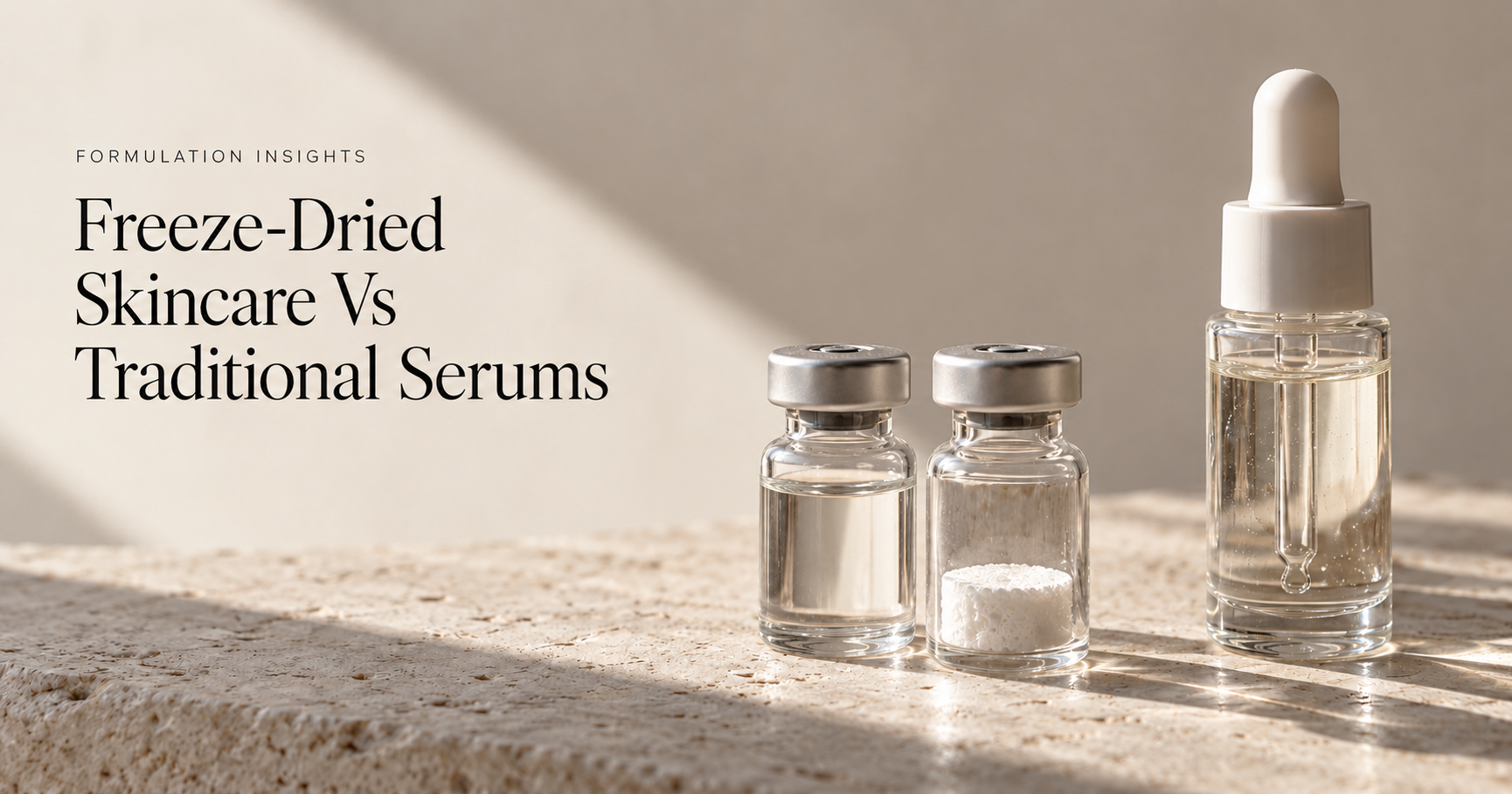
Freeze-dried skincare can suit a brand building a freshly mixed professional product, while a ready-to-use serum often fits a simple daily routine. Choosing between them starts with the product’s purpose, the intended user and the evidence needed to support the finished formula.
For skincare brands, distributors and professional beauty businesses, this decision affects more than the ingredient story. It changes packaging, application instructions, development work and the cost of each usable application. A powder-and-activator set also asks customers to take an extra step, which needs a clear purpose.
This guide compares the two formats from a product development and manufacturing perspective. It focuses on topical cosmetic skincare, including products for salons, spas and homecare collections.
1. Understanding The Two Skincare Formats
What Is Freeze-Dried Skincare?
Freeze-dried skincare, also called lyophilized skincare, contains a formula component that has undergone freezing and drying under vacuum. During primary drying, ice changes directly into vapor; secondary drying removes additional bound water. This creates a dry material that may appear as a porous cake rather than loose powder.
A common cosmetic presentation pairs this material with a separate liquid activator. The user mixes the two according to the instructions before applying the resulting skincare product. The activator can contribute to the final texture and application experience, so it belongs in the development brief from the beginning.
For brands considering this format, our Lyophilized Powder OEM And Private Label Manufacturing page introduces powder-and-activator product concepts and customization options.
What Does Fresh Activation Mean?
In this context, activation usually means mixing or reconstituting the dry component with its specified liquid. It describes a preparation step. The word alone does not establish a chemical activation mechanism, greater penetration or better skincare results.
Describe the experience clearly: what to mix, how to mix it, what the mixture should look like and when to use it. Specific instructions are more useful than an unexplained promise of “maximum activity.”
What Are Traditional Serums?
For this comparison, traditional serums are ready-to-use skincare products supplied as liquids, gels, emulsions or oils. Customers apply them directly without adding a separate activator. The category therefore includes several formulation systems rather than one standard type of product.
A serum may be developed for hydration, a smoother-looking complexion, visible firmness or another cosmetic objective. Its suitability depends on the complete formula, packaging and supporting evaluation. A dropper bottle is one option; pumps, tubes and individual portions may also fit the brief.
For a brand selling a daily homecare routine, the main practical attraction is straightforward use. Customers can understand where the product belongs in their routine, and staff can demonstrate it without preparing a second component.
Manufacturer’s Note: Define the powder, activator and mixed product as one development project. Evaluating only the dry component leaves important questions about the product customers actually apply.
2. Comparing Stability Performance Packaging And Costs
Decision Factor | Freeze-Dried Powder And Activator | Ready-To-Use Serum |
Preparation | Mixing required before application | Applied directly |
Product Experience | Visible preparation ritual | Convenient routine step |
Formula Evaluation | Dry component, activator and final mixture | Finished serum in its intended pack |
Packaging | Paired components and a mixing method | One product container in many designs |
User Education | Mixing, application and use after mixing | Application and storage instructions |
Commercial Fit | Consider for professional or freshly mixed concepts | Consider for daily homecare and simple routines |
Cost Review | Include drying, paired packaging and assembly | Include formula, filling and dispensing pack |
Performance Claims | Require finished-product support | Require finished-product support |
These are planning considerations rather than universal rankings. A simple powder kit and a highly customized serum can have very different economics from another pair of products.
Stability And Formula Protection
Freeze-drying may help manage the stability of selected ingredients, but the benefit depends on the specific system. Research on lyophilized proteins highlights the importance of formulation, processing conditions, residual moisture and container selection. Freezing and drying can themselves introduce stresses. These pharmaceutical findings explain development principles; they do not prove the performance of a cosmetic serum.
A brand should ask which ingredient needs protection and what comparison supports the choice of format. The relevant question is whether the proposed finished product maintains its specified quality under its intended storage and use conditions.
Ask For A Product-Specific Comparison
When stability is the reason for choosing freeze-drying, discuss how the manufacturer will evaluate that rationale. Agree which characteristics matter, what methods are available and whether a suitable liquid comparison can be developed.
Avoid assuming that every ingredient benefits equally or that a dry appearance establishes retained activity. Ask for the evidence relevant to your particular formula before turning a technical possibility into a marketing claim.
Manufacturer’s Note: Request the reason for freeze-drying this formula. “The ingredient is sensitive” should lead to a discussion of the actual stability concern and how the proposed product will be assessed.
Cosmetic Results And Active Ingredient Content
The format alone cannot establish better cosmetic results. A meaningful comparison needs to consider the products as used: their compositions, application amounts, frequency, user groups and outcome measurements.
A freeze-dried product and a liquid serum may contain different supporting ingredients or deliver different amounts per application. Comparing their packaging photographs or ingredient names will not resolve those differences. If a brand wants to claim superiority, the evaluation must be designed to support that specific comparison.
Powder Weight Is Different From Active Ingredient Content
The mass of a freeze-dried cake can include supporting formulation materials as well as the highlighted ingredient. Research describes the use of stabilizers and bulking agents in lyophilized formulations. Reconstitution volume also influences the composition of the final mixture.
For a product brief, distinguish total dry fill from the amount of the named ingredient, then define the volume of activator used. This makes supplier discussions clearer and helps prevent misleading comparisons between kits.
For an anti-aging collection, start with the intended visible benefit and user experience. Then assess whether a freshly mixed kit or a ready-to-use serum offers the more practical route to that brief.
Preservation And Use After Mixing
Freeze-drying should not be treated as a replacement for a microbiological safety strategy. FDA identifies contaminated ingredients, inadequate preservation, unsuitable packaging and consumer handling among possible sources of cosmetic contamination.
For a two-component cosmetic, ask how safety will be assessed for the powder, the activator and the product after mixing. The planned handling and duration of use should be part of that discussion.
Establish The Use Period Before Finalizing The Pack
A kit designed for one immediate application has a different use pattern from a bottle retained for several applications. The manufacturer should establish instructions for the actual finished system rather than borrow a use period from another product.
Do not replace the specified activator with tap water or an unrelated serum. Such substitutions change the product being evaluated. FDA also cautions that adding water to cosmetics can introduce microorganisms and dilute preservatives.
Manufacturer’s Note: Confirm the intended number of applications and use period after mixing before approving vial sizes or carton quantities. These decisions affect the formula, instructions and commercial offer together.
Packaging And Cost Per Usable Application
Request quotations against a shared commercial brief. Specify the target number of applications, intended channel, order quantity, packaging level and required evaluation. Comparing a small paired kit with a larger serum bottle by purchase price alone can obscure the real difference.
A powder-and-activator project may include drying work, two filled components, paired labeling, accessories and assembly. A serum project may require a more expensive dispensing pack or a complex formula. The direction and size of the cost difference need an actual quotation.
Compare Cost Per Usable Application
For professional products, consider how much is used during one appointment and whether any remainder must be discarded. For homecare, consider the intended duration of use and the amount customers can dispense reliably.
Include development samples, packaging trials, testing, instructions and shipping protection in the project budget. For distributors, also review how easily staff and downstream accounts can explain the product. A lower factory price may offer little advantage if the pack creates avoidable waste or confusion.
Manufacturer’s Note: Ask for a quotation that states the number of paired components, expected usable applications and included development work. Use the same assumptions when comparing a kit with a ready-to-use serum.
3. Choosing A Format For Your Sales Channel
Professional Salon And Spa Products
A powder-and-activator kit is worth considering when preparation serves a clear role in a professional facial. Staff can explain the product, prepare it according to instructions and incorporate the application into a defined cosmetic routine.
The preparation step can support product storytelling, but the service must still work at the treatment bed. Before committing, test whether staff can open the components, transfer the liquid, mix consistently and dispense the intended amount without avoidable waste.
Evaluate A Complete Appointment Workflow
Ask staff to trial the proposed packaging as supplied. Record preparation time, unclear steps, difficulties with closures and how much usable product remains. Also assess whether the mixed texture fits the planned application and subsequent cosmetic products.
For example, a salon-focused brand might explore a Copper Peptide Lyophilized Powder concept, while another may review an Oligopeptide Lyophilized Powder concept. Ingredient choice and intended use still need evaluation for each finished product.
Professional positioning does not establish suitability for injection, needling or application to damaged skin. This article concerns topical cosmetic products; any proposed use beyond that scope needs its own assessment.
Daily Homecare Products
A ready-to-use serum is a practical starting point when the brief prioritizes quick application, easy replenishment and a familiar place in a morning or evening routine. This can be particularly relevant when customers receive little individual guidance.
A homecare freeze-dried kit can also be considered if users understand the preparation and the product’s purpose. Its instructions need to work independently of a therapist’s explanation.
Test Instructions With First-Time Users
Give intended users the proposed pack and instructions, then observe what they do. Can they identify the paired components, transfer the correct liquid and recognize when mixing is complete? Do they understand whether any product should be retained?
This exercise can reveal whether the pack needs clearer labels, a simpler closure or different illustrations. It also helps a brand decide whether a preparation ritual adds enough value for its particular customer.
Manufacturer’s Note: Evaluate the routine your customer can realistically follow. Choose a mixing format when customers understand its purpose and can use it correctly within their normal skincare habits.
4. A Practical Format Selection Guide
Use the following scenarios to organize an initial discussion with your manufacturer. They illustrate possible development choices rather than predict sales performance.
Brand Brief | Format To Explore First | Main Question To Resolve |
Simple daily hydration step | Ready-to-use serum | Does the texture and pack encourage consistent use? |
Freshly mixed professional facial product | Powder-and-activator kit | Can staff prepare and apply it reliably? |
Formula with an identified liquid stability concern | Evaluate both approaches | Does testing justify the extra processing and packaging? |
Homecare product with minimal guidance | Ready-to-use serum | Can users understand application independently? |
Existing range seeking a distinct professional product | Powder-and-activator kit | Does it add a useful role to the collection? |
Consider The Role Within The Whole Range
A brand can also develop both formats for different jobs. For example, a professional kit could sit alongside a ready-to-use homecare serum, provided their respective uses and benefits are clear.
Avoid creating two products that differ mainly in presentation while leaving customers unsure which to buy. Define the occasion, application and reason for choosing each product before expanding the assortment.
Manufacturer’s Note: Select one clear launch use case before multiplying ingredients, kit sizes or packaging variants. A focused brief makes sample review and early customer feedback easier to interpret.
5. Developing The Right Product With Your Manufacturer
Questions To Ask An OEM Manufacturer
Start with the intended customer and channel, then describe the product experience you want. A professional distributor’s brief may emphasize staff training and treatment quantities, while a homecare brand may prioritize dispensing convenience and repeat purchase.
Ask the manufacturer to explain the proposed format, identify what is already established and separate it from work still needed for your project. Useful discussion points include:
- The reason for choosing a dry or ready-to-use presentation.
- The role of each component and the proposed application amount.
- Packaging options and how customers will dispense or mix the product.
- Available evaluation results and additional project-specific testing.
- Evidence needed for the proposed cosmetic claims.
- MOQ, sampling stages and the assumptions behind the quotation.
During sampling, review the complete customer experience rather than approving an ingredient list alone. For a kit, include the activator and intended closures. For a serum, include the proposed dispensing pack. Record acceptance criteria so subsequent revisions address specific issues.
Develop Your Skincare Product With Nebula
At Nebula Cosmetic, we support private label and OEM development of topical skincare concepts, including lyophilized powder-and-activator sets. We can discuss ingredient direction, mixed texture, packaging and application instructions around your intended market and channel.
If you are comparing formats, send your target customer, desired cosmetic benefits, sales channel and packaging expectations. These details create a useful starting point for reviewing suitable options and the evaluation your project will require.
Explore Our Lyophilized Powder OEM And Private Label Solutions or Discuss Your Product Brief With Nebula.
Frequently Asked Questions
Is Freeze-Dried Skincare The Same As Lyophilized Skincare?
The terms refer to the same drying approach. For a particular product, confirm whether the complete dry formula or only an ingredient underwent lyophilization.
Is Freeze-Dried Skincare Always Better Than A Liquid Serum?
No. Choose according to the finished formula, supporting evaluation and intended use. A preparation step needs a clear benefit for the product brief.
Can Freeze-Dried Skincare Be Used At Home?
A product may be designed for homecare when its safety, instructions and packaging support that use. Professional packaging should not automatically be assumed suitable for unsupervised home use.
How Long Can A Product Be Used After Mixing?
Follow the instructions established for that specific powder-and-activator system. There is no universal use period for every freeze-dried cosmetic.
Does Freeze-Drying Make Skincare Preservative-Free Or Sterile?
Those properties cannot be inferred from the format. Any such claim needs appropriate evidence for the relevant finished product and components.
Can A Brand Offer Both Formats?
Yes. Define a distinct use and application experience for each, then assess whether both products contribute to a clear, manageable range.
You May Also Like
Develop Your Skincare Products
Looking to launch your own skincare line? Our experienced team can support you through every stage of the development process. From custom formulation and ingredient selection to packaging and full-scale manufacturing, we provide complete OEM and private label solutions tailored to your brand.
