
Lyophilized Powder And Activator | How The System Works
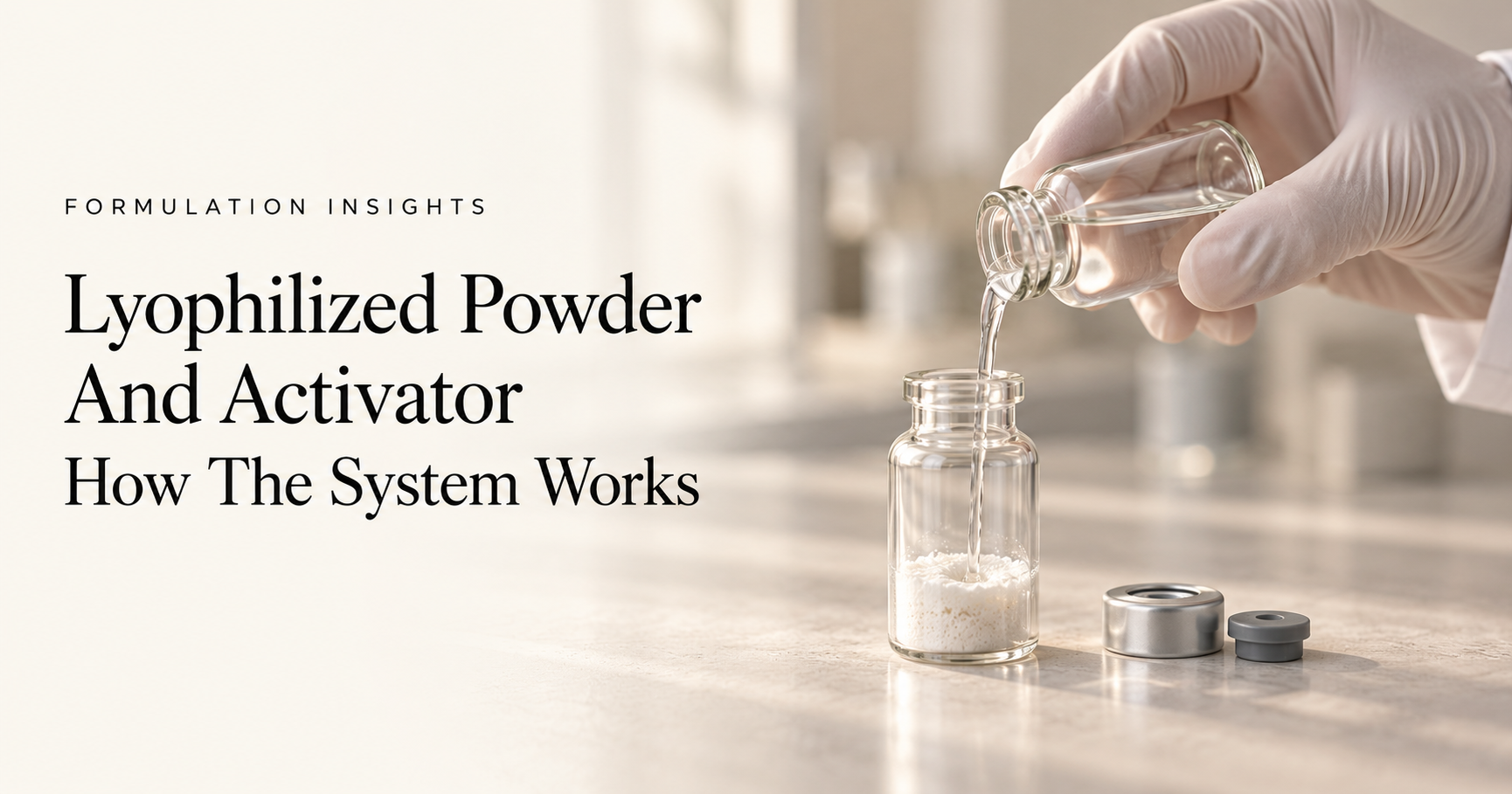
A lyophilized powder and activator kit stores two parts of a skincare formula separately until preparation. The dry component is combined with its specified liquid to create the product applied to the skin. Both components, their quantities and the mixing method belong to one product design.
For skincare brands and professional distributors, understanding this relationship helps explain the format clearly and develop a kit that works in practice. The powder carries part of the formula, while the activator contributes the liquid phase and may provide other formulation functions. Neither bottle should be evaluated in isolation.
This guide explains what happens during preparation, why the matched activator matters and how manufacturers connect formulation with packaging and instructions. It covers topical cosmetic systems for professional skincare and appropriately developed homecare products.
1. Understand The Two Components
| Component | Role In The Product | What To Specify |
| Dry Formula | Supplies ingredients in a freeze-dried presentation | Composition, total fill and relevant ingredient content |
| Matched Activator | Supplies the liquid phase and its formulation contribution | Composition, fill quantity and compatibility |
| Prepared Mixture | Becomes the cosmetic product applied to skin | Texture, application amount and supported use period |
| Packaging And Instructions | Enable correct preparation and dispensing | Component pairing, transfer method and handling steps |
What Is The Lyophilized Powder?
Lyophilization, or freeze-drying, removes water from a prepared material through freezing and drying under vacuum. Primary drying removes ice by sublimation; secondary drying removes additional moisture. The resulting material may appear as a porous cake inside a vial rather than a loose powder.
In a cosmetic kit, that dry material can include the highlighted skincare ingredient and supporting formulation materials. Its total weight therefore does not necessarily represent the quantity of the ingredient named on the front of the carton.
Ask the manufacturer to specify what the powder contains and how its quantity is expressed. A larger cake, a stronger color or a heavier total fill does not by itself establish greater cosmetic performance. The relevant product is the formula prepared according to its instructions.
What Is The Activator?
The activator is the liquid developed to combine with the dry component. Depending on the formula, it may include water, humectants or other compatible ingredients. Its composition also contributes to the properties of the final mixture.
“Activator” is a product description rather than a guarantee of a particular chemical reaction. In many cosmetic systems, the preparation step is reconstitution: the dry material is brought into a usable liquid form. Any more specific activation mechanism needs its own explanation and evidence.
For example, Nebula’s current Copper Peptide Lyophilized Powder concept pairs its dry formula with a panthenol-enriched activator. That pairing illustrates a particular product design; other systems may use different liquids and require different instructions.
Manufacturer’s Note: Describe a kit as a matched formulation system. The activator is part of the product specification, even when its appearance resembles a simple clear liquid.
2. Understand What Happens During Mixing
Reconstitution Creates The Applied Formula
As the specified liquid contacts the dry material, the components combine to form the intended mixture. The finished appearance depends on the formulation. A product may be designed as a clear solution or another defined presentation; clarity alone is not a universal acceptance criterion.
Research on lyophilized formulations identifies reconstitution behavior as a development consideration alongside the dry product’s characteristics. Formulation, processing and container choices all need consideration. Pharmaceutical research provides useful background principles, but its results do not establish how a particular cosmetic kit will behave.
For a brand, the useful question is practical: what should the user do, and what should a correctly prepared sample look and feel like? Agree this description during development, then translate it into instructions suitable for the intended audience.
The Mixing Ratio Sets The Final Composition
The specified powder fill and activator quantity determine what is prepared. Adding extra liquid changes the proportions of the mixture; using too little also produces a different composition from the one developed.
A “one-to-one” set often means one powder container paired with one activator container. It does not mean equal weights or equal volumes. The carton should explain the actual preparation method without requiring users to interpret a supplier’s internal terminology.
Also distinguish vial capacity from fill quantity. A bottle with space above its contents is not necessarily underfilled. The agreed fill specification and usable transfer amount matter more than whether the container looks full in a photograph.
Manufacturer’s Note: Confirm whether the instructions require transferring the entire activator or a measured portion. Design the packaging around that decision so users can prepare the intended formula consistently.
Appearance And Mixing Time Need Product-Specific Criteria
Define the acceptable appearance after preparation, including relevant color, uniformity and texture characteristics. If the formula should dissolve completely, establish how the user will recognize that endpoint and what to do if it does not occur.
Avoid setting an arbitrary mixing time because another product dissolves quickly. Ask the manufacturer to evaluate the actual formula and pack under the proposed method. Any claimed preparation time should reflect that evaluation.
Cloudiness, foam or visible residue should be assessed against the product’s specification. Some appearances may be expected for a particular system; others may indicate a preparation or quality issue. Users need a clear instruction, rather than being left to improvise.
Manufacturer’s Note: Establish a visual reference for correct preparation during sampling. If a sample behaves unexpectedly, record the component codes and preparation conditions for investigation instead of adding unapproved liquid.
2. Design Preparation Around The Intended User
Follow The Finished Product Instructions
Preparation instructions should identify the correct paired components, the amount to transfer and the permitted mixing action. They should also explain application, the period of use after mixing and disposal of any remainder.
The exact opening and transfer method depends on the packaging. A snap-off container, a removable closure and a purpose-designed transfer accessory create different user tasks. Select the method before finalizing illustrations or training materials.
For development discussions, the sequence below identifies what needs to be established. It is a review framework, not a substitute for the directions supplied with a finished kit.
| Preparation Stage | What The Instructions Should Explain | What To Check In A User Trial |
| Identify | Which components belong together | Users select the correct pair |
| Open | How each closure is operated | Opening is understandable and manageable |
| Transfer | Which liquid quantity is added | The intended amount can be transferred |
| Mix | Method and expected endpoint | Preparation matches the reference sample |
| Apply | Intended area, portion and routine | Dispensing suits the supported application |
| Finish | Use period, remainder and disposal | Users understand what happens after preparation |
Match The Kit To A Professional Appointment
In a salon or spa, preparation must fit the actual appointment sequence. Observe staff using the proposed pack alongside the products already included in the cosmetic routine. Record preparation time, unclear steps and the amount that can be dispensed reliably.
Consider how instructions will reach new staff and downstream accounts. A distributor may need clear component photographs, translated directions and a short demonstration using the actual pack. Confirm what the manufacturer can provide and what needs adaptation.
A professional appearance does not establish compatibility with every procedure. Define the specific topical cosmetic application and review any proposed combination separately. Product development should not assume injection, needling or use on damaged skin from the presence of a vial and liquid.
Make Homecare Instructions Work Without Demonstration
A homecare user may have no therapist available to explain a closure or correct a misunderstanding. Test the proposed kit and instructions with first-time users before deciding that the professional presentation can be sold unchanged through retail channels.
Observe whether users recognize the matched pair, transfer the correct quantity and understand when preparation is complete. Ask them to explain what they would do with a remainder and how they would store the unopened kit.
Use the findings to simplify packaging and wording. A photograph of the actual transfer accessory may explain a step more clearly than an abstract icon. Preserve the evaluated instructions when creating social content or translated materials.
Manufacturer’s Note: Test the kit with its intended user. A preparation method that works during a guided factory demonstration may still need clearer packaging or instructions for a busy salon or homecare routine.
3. Connect Storage Safety And Packaging
Unopened Shelf Life And Use After Mixing Are Different
An unopened kit and its prepared mixture are different storage situations. A shelf-life proposal for the sealed components does not establish how long a mixed product may be retained.
Ask what evidence supports the proposed conditions for both components, including the chosen containers and closures. Separately establish the intended period after preparation and the instructions that follow from that evaluation.
Nebula’s current copper peptide kit directs immediate use and disposal of unused mixture. That is a product-specific instruction, not a universal rule for every two-part cosmetic. A system intended for longer use needs appropriate development and supporting evaluation.
Preservation Must Address The Complete System
FDA identifies contaminated ingredients, inadequate manufacturing conditions, ineffective preservation, unsuitable packaging and consumer handling as possible sources of cosmetic contamination. It also cautions that adding water to cosmetics can introduce microorganisms and dilute preservatives.
For a powder-and-activator system, discuss the safety strategy for both components and their intended use together. Ask how the development plan considers preservation and handling, and which tests are relevant to the finished design. A dry presentation or small vial should not be treated as proof of sterility.
Do not instruct customers to replace the specified activator with tap water or a different skincare product. Such substitutions change the composition and handling conditions from those established for the kit.
Packaging Protects The Product And Guides Preparation
Evaluate the pack for protection during its intended storage and distribution, as well as for appearance. Lyophilized-product development literature discusses containers and closures as part of the overall product design.
For the user, the same packaging must identify paired components, open as intended and allow preparation without avoidable waste. Review the dispensing arrangement and the quantity users can actually transfer. Changes to accessories or closures should be assessed before they are introduced to production.
If a set contains several pairs, make the count clear: one pair and one retail carton are different order units. Labeling should help users identify the correct components without needing to rely solely on bottle color or size.
Manufacturer’s Note: Approve storage, preparation and disposal instructions together. The component quantities, packaging and written directions should all support the same evaluated pattern of use.
4. Develop The System With Your Manufacturer
Start With The Desired Product Experience
Describe the intended customer, cosmetic benefit and application setting before selecting a vial size. Explain why a freshly mixed format fits the collection and what experience you want after preparation.
A professional facial concept may prioritize reliable portions and easy staff preparation. A homecare concept may place more weight on opening, clear identification and independent understanding. Those priorities help the formulator and packaging team develop around the same brief.
Ask whether an established matched system can provide a suitable starting point. If customization is proposed, clarify which parts will change and which evaluations need updating. A new activator should be considered a formula decision rather than a purely cosmetic packaging change.
Evaluate Samples As Complete Kits
Request samples that include the proposed powder, activator and relevant dispensing components. State whether the trial is intended to assess the formulation concept, user experience or a production-ready configuration.
Review appearance before mixing, preparation behavior and the final texture. Then assess how the application fits the intended cosmetic routine. Keep feedback linked to sample codes and versions so a later revision can be compared meaningfully.
Before production approval, identify the formula, quantities, closures, artwork and instructions being accepted. Agree how the manufacturer will communicate substitutions or revisions, and which characteristics will be checked during routine batch release.
Define Commercial Units And Support Materials
Request a quotation that specifies what is delivered in each order unit. Confirm the number of powder vials, activator containers, accessories and matched pairs per carton. Ask which formula, printing or packaging minimums affect the order.
Include sampling, relevant testing, instructions and assembly in the cost discussion. For professional distribution, establish responsibility for technical materials and preparation demonstrations. A complete proposal should explain both the physical kit and the information needed to use it correctly.
Manufacturer’s Note: Use one agreed configuration across the sample record, quotation and artwork. This reduces confusion when “vial,” “pair,” “set” and “box” are used differently in commercial discussions.
At Nebula Cosmetic, we support private label and OEM discussions for matched freeze-dried skincare systems. Explore our Lyophilized Powder Manufacturing Solutions or Discuss Your Powder And Activator Project. Share your target customer, desired cosmetic benefits and preferred kit presentation so we can review a suitable development starting point.
Frequently Asked Questions
Is An Activator Just Water?
Its composition depends on the product. It may contain water and other formulation ingredients. Use the supplied specification and matched liquid rather than assuming any water-based product is equivalent.
Does Activation Create New Active Ingredients?
The word often describes reconstitution before use. It does not by itself establish a chemical reaction or the creation of a new active ingredient. Ask for an explanation of any specific mechanism claimed.
Can The Powder Be Applied Directly To Skin?
A product designed for mixing should be prepared according to its instructions. Direct use of the dry component is a different application and should not be assumed suitable.
Must Every Prepared Product Be Clear?
No. Compare the mixture with the appearance established for that formula. The manufacturer should specify the expected endpoint and how users should respond to unexpected residue or other changes.
Can A Mixed Product Be Kept In The Refrigerator?
Refrigeration should not be used to invent a longer use period. Follow the storage and disposal instructions supported for that product. If the kit specifies immediate use, discard the remainder as directed.
Does A Two-Part Format Guarantee Better Results?
No. Cosmetic results depend on the finished formula and its use. Stability or performance advantages need relevant evidence; the presence of two containers is not a comparative test.
You May Also Like
Develop Your Skincare Products
Looking to launch your own skincare line? Our experienced team can support you through every stage of the development process. From custom formulation and ingredient selection to packaging and full-scale manufacturing, we provide complete OEM and private label solutions tailored to your brand.
