
Freeze-Dried Skincare Packaging | Vials And Kit Guide
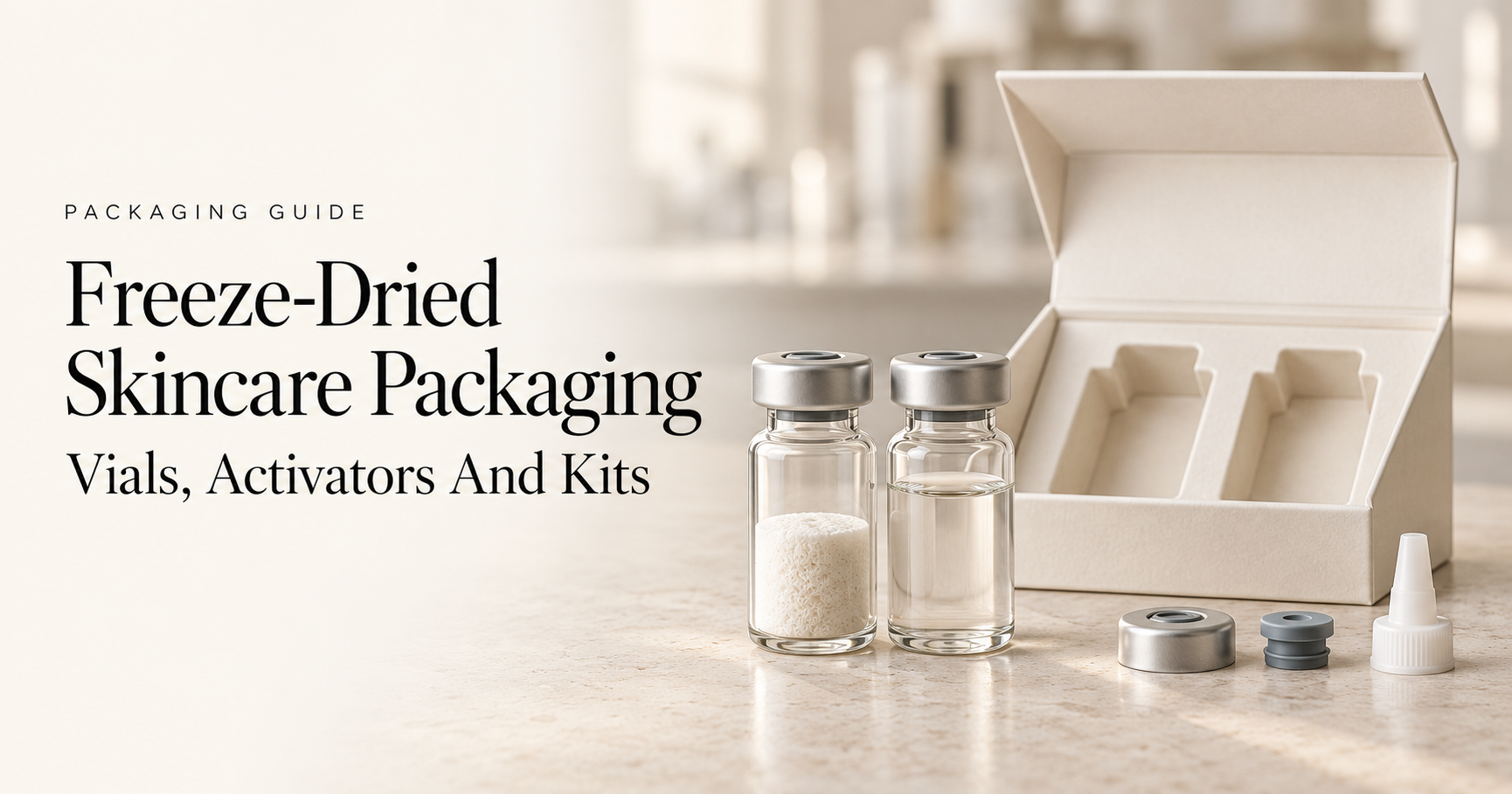
Freeze-dried skincare packaging is a coordinated system of containers, closures, transfer components and outer packaging. Each part needs to suit the formula and the way customers will prepare it. Selecting a vial from a photograph is therefore only an early design decision.
For private label skincare brands, the practical goal is to define a pack that can be manufactured consistently, protect the product under its intended conditions and make preparation understandable. The powder container and activator bottle may look similar, but their specifications and roles need separate attention.
This guide explains the packaging decisions behind topical powder-and-activator kits. It focuses on component selection, dimensional fit, dispensing and approval records, helping brands turn an initial visual concept into a clear brief for an OEM manufacturer.
1. Map The Packaging System Before Choosing Components
Separate Primary Packaging From Presentation
Primary packaging contains or directly contacts the product. In a two-component kit, that includes the powder vial and its closure, plus the activator container and closure. Transfer or dispensing accessories may also contact the formula during preparation.
The carton, insert, sleeve and shipping arrangement serve different purposes. They organize and protect the components, carry information and present the brand. An attractive outer box cannot establish whether the primary containers suit the formula.
Start by listing the parts of the proposed kit and assigning each a function. This makes it easier to identify what the manufacturer is quoting and what still requires development.
| Packaging Element | Main Function | Specification To Clarify |
| Powder Container | Holds the dry component through the relevant process and storage | Material, geometry, capacity and neck dimensions |
| Powder Closure | Closes the container as part of a matched assembly | Stopper or closure design, material and fit |
| Activator Container | Holds the matched liquid until preparation | Material, fill quantity and dispensing arrangement |
| Transfer Accessory | Helps deliver the specified quantity | Fit, contact materials and usable transfer amount |
| Carton And Insert | Organize and protect the complete kit | Pair count, component positions and retention |
| Labels And Directions | Identify components and explain use | Readable information and correct version |
Define The Complete Product Before The Carton Count
Specify the intended formula, preparation method and use pattern before multiplying the number of pairs in a box. One powder vial plus one activator can be one pair; the finished retail unit may contain one pair or several.
Confirm whether the entire activator is transferred or a measured portion is required. Also establish how the prepared product will be dispensed and the period of use after mixing. These decisions influence the containers and accessories worth sampling.
Our Lyophilized Powder OEM And Private Label Solutions page introduces the broader product format. The final pack should be specified around the actual project rather than selected independently of its formulation.
Manufacturer’s Note: Ask for a component list at quotation stage. State what is included in one pair and one carton, including closures, transfer pieces, inserts and printed materials.
2. Select The Powder Vial And Closure Together
Check Material Geometry And Process Fit
Ask the manufacturer which container is suitable for its proposed filling and freeze-drying process. Container selection belongs in the technical discussion before decoration or artwork is approved.
Lyophilized-product research discusses how container geometry, fill volume and closure selection interact with formulation and processing. These pharmaceutical principles explain why a pack change may require technical review; they do not create a universal specification for cosmetic vials.
For your project, request the container drawing, material description and supplier reference. Ask whether the proposed part has been evaluated with the formula and process or is still a candidate for trials. A familiar bottle silhouette does not establish an identical production component.
Distinguish Capacity Fill And Mixing Space
Container capacity describes the space a container can hold; fill quantity describes what is actually supplied. For a dry component, also distinguish the liquid quantity filled before drying from the resulting dry mass and the volume added during preparation.
These values serve different purposes. The vial must suit the processing arrangement and accommodate the specified preparation without making the product difficult to mix or dispense. A larger capacity is not evidence of more active ingredient.
Ask the manufacturer to record the relevant quantities in the sample specification. Do not choose a larger vial simply to make the product look more substantial if it creates unnecessary packaging volume or complicates dispensing.
Manufacturer’s Note: Confirm which quantity a size description refers to. “5 mL vial,” “5 mL liquid fill” and a specified dry fill are different statements and should not be used interchangeably.
Understand The Stopper And Outer Seal
In a stoppered, crimped vial assembly, the inner stopper and the outer seal perform different functions. West’s technical discussion explains how vial, stopper and seal dimensions work together, including the importance of their fit and the assembled closure. Its guidance concerns pharmaceutical systems and should be used as background rather than copied into cosmetic acceptance limits.
For the cosmetic pack, ask which exact components form the proposed assembly and how its performance will be assessed. The visible cap color is a design detail; it cannot confirm the sealing function of the whole combination.
Review opening as a separate user task. Removing a decorative button may only expose the stopper rather than open the vial for pouring. Instructions need to show what the supplied pack actually requires, without encouraging customers to improvise tools or handling methods.
Manufacturer’s Note: Approve the vial, stopper and seal as a documented combination. If one component changes supplier or dimensions, ask which fit and performance checks need to be repeated.
3. Specify The Activator Container And Transfer Method
Choose Around The Required Transfer Quantity
The activator pack should deliver the amount specified for the matched formula. Consider the liquid, the container and the transfer method together rather than selecting a bottle based solely on its appearance beside the powder vial.
Options for discussion may include an openable matched vial, a suitable dispensing bottle or a compatible transfer accessory. Availability and suitability depend on the system. None should be assumed interchangeable without review.
If a measured portion is required, establish how the user will obtain it reliably. If the instructions call for the entire activator, assess the amount that can actually be transferred. Liquid remaining inside a shoulder or dispensing component may affect whether the intended preparation is achieved.
Review Contact Materials And Dispensing Components
Identify the materials that contact the activator during storage and the prepared formula during transfer or dispensing. Ask the manufacturer how the proposed arrangement will be evaluated for the relevant formula, conditions and period of use.
A dropper, nozzle or adapter may affect the product experience even when the bottle itself is unchanged. Observe leakage, difficult attachment, inconsistent dispensing and inaccessible remainder during sampling. Record the exact accessory used so a production alternative is not substituted silently.
Avoid assuming that a particular material is always best. Glass, polymers and elastomers require evaluation in their actual roles and combinations. Ask for product-specific evidence and a clear plan for any outstanding work rather than relying on broad material claims.
Consider Integrated Mixing Packs As A Separate Project
Dual-chamber or integrated mixing concepts can be explored when the manufacturer and packaging supplier support them. Their feasibility should be assessed around filling, component separation, mixing and delivery of the finished formula.
Ask what has already been demonstrated with the proposed format. A mechanism may look convenient in a drawing while still needing work on transfer, complete mixing or dispensing. Confirm sampling access, tooling needs and commercial minimums before treating it as an alternative to an established two-vial set.
For an initial launch, compare the additional work with the value the intended customer would receive. An integrated pack deserves a specific reason in the brief and a development plan that reflects its complexity.
Manufacturer’s Note: Test the complete transfer path using the proposed formula. A bottle that holds the correct fill does not automatically deliver the intended amount through every accessory.
4. Build A Kit That Is Clear And Efficient To Assemble
Make Matched Components Easy To Recognize
Define how powder and activator containers are identified within the kit and after removal from the carton. Clear component names and product references can help prevent confusion when several formulas share similar bottles.
Use cap or label colors as supporting cues rather than the only identification method. Review the smallest printed text on a physical sample, including how curved glass affects readability. Confirm the information needed for the target market before printing.
If the carton contains different formulas, check every powder-and-activator combination. A mixed assortment requires an unambiguous pairing method and records that identify what belongs in each finished kit.
Choose Inserts Around Retention And Removal
An insert should hold the proposed components in the intended arrangement while allowing users to remove them. Compare actual samples of the selected structure instead of approving the tray from an image alone.
Paperboard, molded fiber or foam structures can be discussed with the packaging supplier, subject to feasibility and performance. Assess the component retention, fit and removal experience for the exact bottles. A material description alone does not establish transport protection or environmental performance.
Check the closed box as well as the open display. Excess movement, pressure on a closure or interference with an accessory may only become apparent once the pack is assembled. Agree what the manufacturer will inspect during routine assembly.
Keep Configuration And Order Units Explicit
Specify both the contents and their arrangement. For example, three powder vials and three matched activators form three pairs; a carton holding that configuration is one retail unit containing six bottles. This is an explanatory example, not a recommended universal pack size.
Confirm where instructions and accessories sit, and whether individual pairs have their own sleeves or cartons. These choices affect assembly steps, packing volume and quotation assumptions.
Manufacturer’s Note: Request a physical assembled sample before committing to printed quantities. Check the lid, insert, bottles, accessories and instructions together, including removal and replacement of components.
5. Validate The Selected Pack Before Production
Match Evaluation To The Actual Formula And Pack
A packaging evaluation should identify the formula version, component references and intended conditions. Separate existing evidence from work planned for your customized configuration.
Discuss protection during unopened storage, formula compatibility, closure performance and the intended preparation. FDA identifies inadequate packaging, storage and handling among possible contributors to cosmetic contamination. Packaging must be considered with the overall safety strategy, rather than as a standalone guarantee.
Keep unopened shelf life and use after mixing distinct. Nebula’s current Copper Peptide Lyophilized Powder concept specifies immediate use after preparation. A new dispensing pack or reclosable bottle does not itself justify keeping the mixture longer.
Separate Product Protection From Transport Testing
Review the primary container and closure for the product, then assess the assembled kit and shipping arrangement for the intended distribution route. These reviews answer different questions, and both need an agreed scope.
A courier shipment from the factory to your office can reveal issues, but it should not be presented as proof that every shipping condition has been validated. Discuss representative handling and any formal testing appropriate to the project with the packaging team.
Document leaks, breakage, closure damage, component movement and artwork abrasion. Link findings to the pack version and identify whether a revision affects the primary container, retail carton or shipping materials.
| Approval Area | Information To Record | Question To Resolve |
| Component Identity | Supplier references, drawings and materials | Are the proposed production parts clearly identified? |
| Dimensions And Fit | Container, closure and accessory combinations | Do the selected parts work together? |
| Formula Compatibility | Formula version and relevant evaluation | Does the pack suit the actual contents and conditions? |
| Transfer And Dispensing | Method and usable quantities | Can users prepare and apply the intended product? |
| Kit And Shipping | Insert, carton and transport arrangement | Are the components organized and appropriately protected? |
| Production Control | Approved references and change procedure | How will supply remain consistent with approval? |
Create An Approval Record That Supports Reorders
Before production, agree the component list, artwork, assembly layout and sample references. Record any conditional approval and the work needed to close it. Keep technical specifications separate from visual preferences so both remain clear.
Ask how substitutions will be proposed and authorized. A change to a stopper, label adhesive, accessory or carton insert may need different checks; it should not be hidden behind an unchanged product photograph.
Manufacturer’s Note: Retain a dated record of the approved complete pack and its component references. Reorders are easier to review when the specification describes the parts rather than relying on the phrase “same as last time.”
For a development discussion with Nebula Cosmetic, share the intended market, application setting, preferred kit configuration and estimated quantities. Our Lyophilized Powder OEM And Private Label Solutions provide a starting point for reviewing matched formulas and packaging. Send Your Packaging Brief To Nebula to discuss suitable options and the evaluation your project may require.
Frequently Asked Questions
Can Any Cosmetic Vial Be Used For Freeze-Drying?
Suitability needs review against the proposed process, formulation and closure arrangement. Ask the manufacturer to confirm which exact container has been assessed rather than selecting by appearance alone.
Must Powder And Activator Bottles Be The Same Size?
Matching dimensions are a presentation option. Select each container around its contents, preparation role and handling requirements. Different sizes still need clear identification as a matched pair.
Does A Flip-Off Button Fully Open The Vial?
It may expose an inner stopper while leaving that stopper in place. Review the actual closure and opening directions. A familiar cap appearance does not establish the preparation method.
Can A Dropper Cap Replace The Original Closure?
Only as part of an assessed product arrangement. Confirm when the dropper is attached, how it fits, which materials contact the product and whether the intended use remains consistent with the instructions.
Does A Dual-Chamber Pack Remove The Need For Testing?
No. It introduces its own filling, separation, mixing and dispensing questions. Evaluate the complete system with the intended formula and user before selecting it for production.
What Should A Packaging Quotation Include?
Request defined order units, component references, quantities, decoration, inserts, accessories, assembly and agreed evaluation work. Ask which minimums, tooling or sampling charges affect the proposed configuration.
You May Also Like
Develop Your Skincare Products
Looking to launch your own skincare line? Our experienced team can support you through every stage of the development process. From custom formulation and ingredient selection to packaging and full-scale manufacturing, we provide complete OEM and private label solutions tailored to your brand.
