
Professional Freeze-Dried Skincare | Salon Packaging Guide
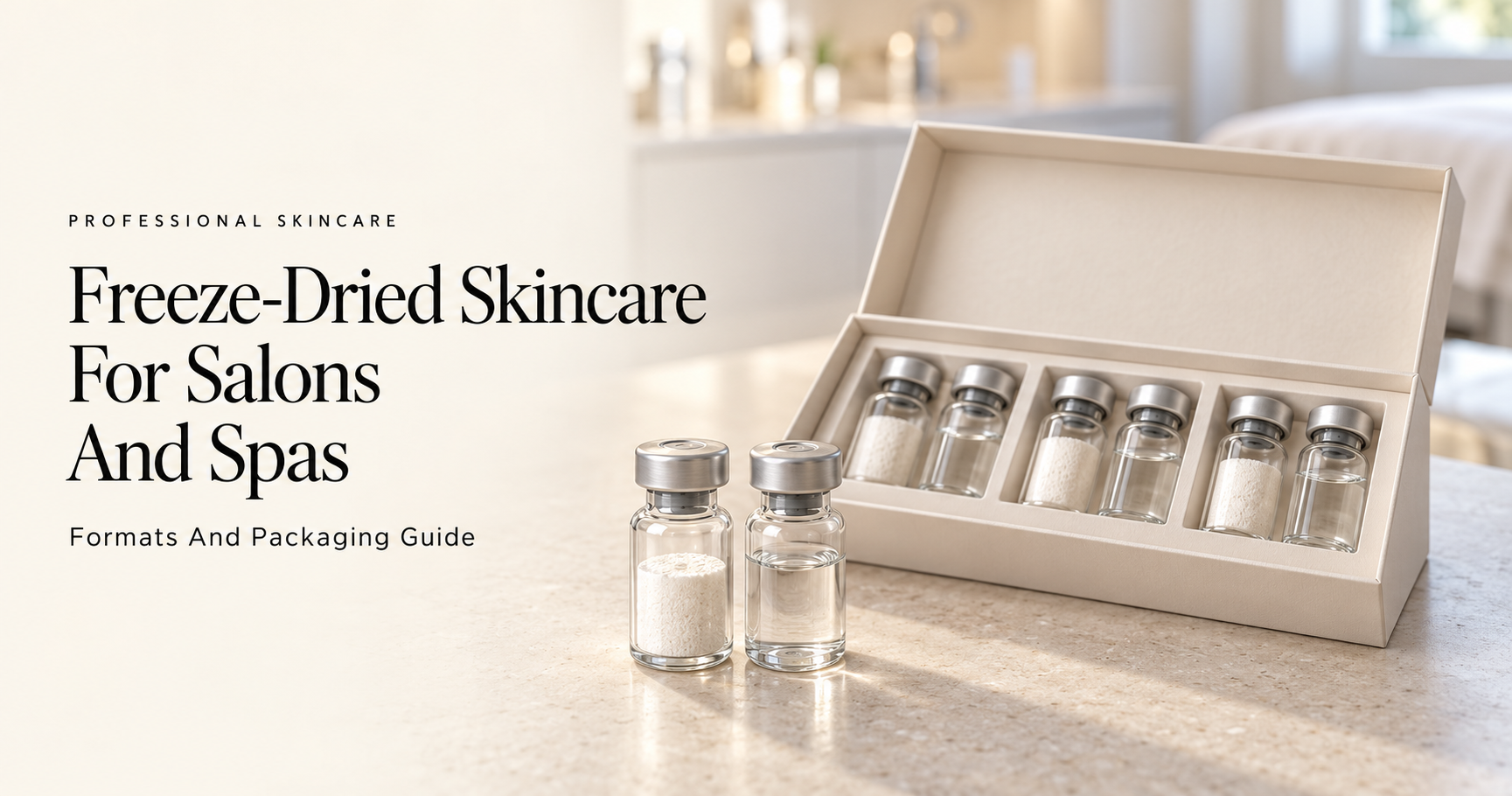
Professional freeze-dried skincare should be packaged around the way a salon or spa will prepare, apply and replenish it. A useful design connects the formula with a practical portion, a clear pairing of components and a carton that staff can manage during everyday appointments.
For skincare brands and distributors, the packaging decision begins before artwork. A visually appealing box can introduce the product, but the kit inside must also open easily, communicate the intended preparation and deliver the agreed amount. Those details affect the customer experience and the cost of each usable application.
This guide focuses on topical powder-and-activator skincare for professional cosmetic routines. It compares kit configurations, explains portion planning and outlines the sample checks to complete before choosing a private label presentation.
1. Start With The Professional Skincare Routine
Define The Product’s Place In The Appointment
Describe the intended cosmetic routine before selecting vial sizes or carton counts. Identify who prepares the product, when mixing happens and how the application fits the surrounding skincare steps. The portion may need to cover the face alone or another specifically assessed area.
Define the product role as clearly as the preparation. A brand may explore a concept positioned around a hydrated appearance, smoother-looking skin or visible firmness. The finished formula and supporting evaluation should determine the benefits that can be communicated.
A Copper Peptide Lyophilized Powder concept is one possible starting point for a professional collection. Choosing a product name is only the beginning; its final portion, instructions and supported cosmetic use must also fit the appointment.
Distinguish Professional Stock From Retail Homecare
Products kept for staff use during appointments have different presentation needs from a carton sold for home use. Staff may work from a storage drawer and follow a written routine; a retail customer needs to understand the kit independently.
Decide which channel the first configuration serves. If the brand wants both, review the professional and homecare packs as distinct use cases. The same ingredient concept does not automatically justify identical quantities, opening methods or instructions.
For distributors, also consider how a product will reach individual accounts. Confirm whether salons order whole cartons, receive individually packed pairs or require a separate evaluation pack. Design the information that travels with each unit accordingly.
Manufacturer’s Note: Write a short appointment brief before selecting the box. State the intended application, user and preparation setting so the formula and packaging teams work toward the same experience.
2. Compare Practical Kit Configurations
Individual Powder And Activator Pairs
One dry component paired with one matched activator provides a straightforward unit for development. Each pair can be identified, prepared and evaluated as a complete system. It may be configured for a single appointment when the supported instructions and usable quantity permit that use.
“Pair” describes the component grouping. It does not establish an application amount, use period or equal quantities in the two containers. Agree those details separately and ensure the final labeling describes them clearly.
Individual cartons or sleeves can help keep a pair together, while also adding packing volume and assembly work. Ask whether separate outer packaging is necessary for your distribution model and which instructions must remain available when a pair leaves the larger carton.
Multi-Pair Cartons For Professional Stock
A professional stock carton can hold several matched pairs without requiring each one to have a large presentation box. The insert should keep the components secure and make it clear how many complete pairs remain.
Plan the arrangement around recognition and replenishment. Powder vials and activators can be grouped in paired positions or in clearly identified sections, provided staff can select the correct combination. Review the actual tray rather than approving its drawing alone.
A larger carton count does not change how an individual pair is used. If the prepared product is intended for immediate application, grouping multiple pairs in one box does not authorize retaining a mixed remainder for a later appointment.
Evaluation And Professional Introduction Kits
An introduction kit can help a salon review a product before selecting ongoing stock. It may contain a limited number of pairs with the preparation materials needed for evaluation. A brand should define what the kit is intended to demonstrate and how feedback will be collected.
If several formulas are included, make each matched combination unmistakable. Avoid leaving staff to identify activators from bottle color alone. Confirm that the contents reflect the proposed commercial product, and explain any differences between evaluation and production packaging.
Configuration | Use Case To Explore | Main Packaging Question |
Individually Packed Pair | Separate distribution or product evaluation | Does each unit retain clear identification and directions? |
Multi-Pair Professional Carton | Repeated staff use from salon stock | Can staff select and count complete pairs easily? |
Introduction Kit | Guided review of a new professional concept | Are the sample contents and feedback purpose clear? |
Separate Homecare Carton | A product specifically developed for independent use | Can customers prepare and use it correctly without staff help? |
These are configuration options for discussion, not claims that every formula or packaging supplier supports every format. Confirm feasibility, minimum quantities and development work for the selected system.
Manufacturer’s Note: Compare packaging configurations using the same formula and component quantities. This helps reveal which cost differences come from presentation rather than a change to the product itself.
3. Plan Portions And Cost Per Application
Define The Amount Needed For The Intended Use
Review usable quantity through an application trial. Ask the intended professional user to prepare and dispense the sample within the proposed routine, then record whether the amount is appropriate. A nominal fill quantity alone does not show how much can be transferred and applied.
Consider spreadability, the intended area and the dispensing method together. Avoid assigning a universal face-and-neck dose simply because a particular vial size is readily available. The manufacturer should establish the portion and instructions for the finished design.
Separate container capacity from liquid fill and total dry mass from featured ingredient content. These quantities answer different questions. Clear specifications make it easier to compare samples and prevent a larger bottle from being mistaken for a more concentrated product.
Reduce Remainder Through Better Portion Design
A product intended for immediate use should have packaging that supports that instruction. Nebula’s current copper peptide concept directs immediate application after mixing and disposal of the unused mixture. That instruction belongs to that product; another use pattern needs its own assessment.
If a trial leaves substantial remainder, discuss a more suitable configuration with the manufacturer. Possible questions include the component quantities, dispensing losses and whether the proposed application amount fits the formula. Do not solve the issue by improvising a longer storage period.
Document the result before approving the retail unit. A carton with more vials is not necessarily economical if the supported routine leaves an avoidable remainder from every prepared pair.
Compare Costs Using Complete Usable Units
Compare the cost of a complete powder-and-activator pair, including the accessories needed to prepare it. For appointment planning, relate that cost to the portion supported by the product instructions and application trial.
As an illustrative calculation, a carton costing $60 and containing six complete pairs has a purchase cost of $10 per pair. If one pair is intended and suitable for one appointment, that is the kit cost for that use. The example excludes shipping, staff time and the rest of the facial routine; it is not a product quotation.
Use the same assumptions when evaluating suppliers. Confirm whether a quoted “set” means a pair, a carton or another unit, and whether printing, inserts and assembly are included.
Manufacturer’s Note: Approve the portion before multiplying the carton count. An evaluated application amount gives both the salon and the brand a clearer basis for cost planning.
4. Make The Pack Work In Daily Professional Use
Review Opening Transfer And Dispensing
Observe a therapist using the proposed closures and transfer accessories without a demonstration at every step. Record anything that interrupts preparation, including unclear opening directions, awkward transfer or difficulty dispensing the mixture.
Select the method around the actual containers. A removable closure and a purpose-designed transfer accessory create different tasks from a snap-off container. Instructions and training photographs should show the arrangement that will be supplied.
Do not assume a cosmetic vial needs injection equipment. This article concerns topical skincare. Any device-assisted use or application outside the product’s supported cosmetic routine requires separate consideration.
Use Clear Identification And Professional Graphics
Prioritize information that helps staff select the correct product and matched activator. Useful design elements include a readable product name, component identification, preparation directions and accessible batch information. Review artwork requirements with the appropriate target-market adviser before printing.
Use color as a supporting cue. It should not be the only way to distinguish formulas, particularly when an account stocks several kits. Check readability under actual storage and preparation conditions rather than only on a large design-screen preview.
For a professional brand, visual consistency can come from typography, hierarchy and restrained use of color. A complex carton or oversized rigid box should have a practical purpose in the distribution and presentation plan.
Include Instructions That Stay With The Product
Decide where directions will appear when staff remove components from the main carton. A separate printed card, instructions on an appropriate unit pack or another reviewed arrangement may be suitable. A digital demonstration can supplement the information but should not conceal essential steps.
For distributor networks, manage translations and revision versions. A new closure or transfer accessory may require updated photographs and wording even if the ingredient concept is unchanged. Agree who supplies approved content and who checks local adaptations.
Keep cosmetic benefits separate from preparation claims. “Freshly mixed” describes an experience; it does not prove greater efficacy. Use finished-product evidence to support the benefits communicated to salons and their clients.
Manufacturer’s Note: Test identification with the products side by side. Staff should be able to distinguish formulas and matched components from the labels, even when decorative colors look similar.
5. Validate The Packaging And Prepare For Supply
Evaluate Protection And Storage Alongside Appearance
Container and closure selection is part of lyophilized-product development. Research discusses their relationship with processing and product quality; pharmaceutical findings provide background principles rather than specifications for a salon cosmetic.
Ask the manufacturer what supports the chosen primary pack and storage conditions. Review the exact formula, closure and container combination proposed for supply. Separately assess how the carton and shipping protection perform along the intended distribution route.
FDA identifies packaging, storage, preservation and handling among factors that can contribute to cosmetic contamination. A dry component or a small presentation does not establish sterility. [2]
Run A Complete Packaging Trial
Review a sample kit from receipt through storage, preparation and application. Include people who will handle stock as well as the person using the product. A pack that looks good during a sales meeting may raise different questions inside a treatment-room drawer.
Use a shared checklist and link observations to the sample version. The goal is to identify specific changes before purchasing printed components or committing to assembly quantities.
| Review Area | Practical Trial Question | Decision Before Approval |
| Component Pairing | Can staff select the correct powder and liquid? | Clear identification and tray arrangement |
| Opening And Transfer | Can the supplied components be handled as instructed? | Suitable closures and accessories |
| Usable Portion | Does the prepared amount fit the intended application? | Agreed quantities and dispensing method |
| Storage And Counting | Can the account count complete unopened pairs? | Suitable carton size and organization |
| Transport Protection | Are contents protected on the intended route? | Appropriate insert and shipping arrangement |
| Directions And Records | Are instructions and batch details available when needed? | Approved content and traceability arrangement |
If a trial reveals a problem, record the step and its consequence. “The activator is difficult to identify after unpacking” leads to a more useful revision than “the kit needs to look more professional.” Recheck the changed feature before approval.
Manufacturer’s Note: Complete one end-to-end trial with the proposed commercial pack. Confirm that the instructions, component quantities and user experience still agree after any packaging revision.
Build A Focused Private Label Launch Brief
Send the manufacturer the intended customer, cosmetic routine and distribution model, along with the proposed application portion and carton count. State whether the project concerns professional stock, an evaluation kit or a separately developed retail presentation.
Ask for a quotation defining the order unit, formula and packaging minimums, included accessories and assembly work. Agree sampling stages, the evaluation still required and how component changes will be approved. A larger carton quantity should not hide a separate minimum for each printed item.
Start with a manageable configuration and expand when customer feedback supports another format. For a distributor, a clear replenishment pack and practical training materials may deserve priority over multiple decorative box variants.
Manufacturer’s Note: Keep the approved configuration consistent across the sample, quotation and order. State both the number of pairs per carton and the number of cartons being purchased.
At Nebula Cosmetic, we can discuss matched powder-and-activator concepts and packaging around your intended professional channel. Explore our Lyophilized Powder OEM And Private Label Solutions or Discuss Your Salon And Spa Product Brief. Share the intended application and pack configuration so we can review a suitable starting point.
Frequently Asked Questions
How Many Pairs Should A Professional Carton Contain?
Choose the count around the intended stock pattern, reorder plan and packaging feasibility. There is no universal carton size for every salon. Confirm the number of complete powder-and-activator pairs rather than the total number of bottles alone.
Does One Pair Always Equal One Appointment?
Only when that use fits the evaluated quantity and product instructions. Define the intended portion through development and a realistic application trial rather than assuming the relationship from the packaging.
Can One Activator Bottle Be Shared Across Several Powder Vials?
That requires a system designed and assessed for the proposed handling and quantities. Do not replace individually matched pairs with a shared bottle without reviewing the formulation, instructions and safety implications with the manufacturer.
Can The Same Pack Be Used For Homecare?
Homecare needs its own review of user understanding, opening, preparation and supported use. A professional kit should not automatically be sold for independent use without that assessment.
Does A Professional Freeze-Dried Kit Need A Rigid Gift Box?
A rigid box is a presentation choice. Compare it with simpler configurations against protection, storage, branding and cost requirements. The primary pack and instructions still need to work regardless of outer-box style.
Can A Prepared Remainder Be Saved For The Next Client?
Follow the instructions for the specific product. If immediate use and disposal are specified, discard the remainder as directed. Do not create a longer use period or a multi-client application pattern to reduce perceived waste.
You May Also Like
Develop Your Skincare Products
Looking to launch your own skincare line? Our experienced team can support you through every stage of the development process. From custom formulation and ingredient selection to packaging and full-scale manufacturing, we provide complete OEM and private label solutions tailored to your brand.
